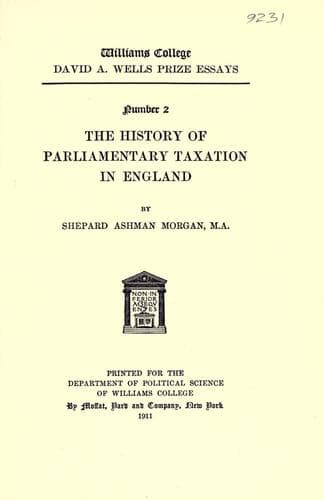
The History of Parliamentary Taxation in EnglandMorgan, Shepard Ashman
History
The History of Parliamentary Taxation in England
Morgan, Shepard Ashman
Taxation -- Great Britain; Taxation -- Great Britain -- History
Similar success did not meet Henry, when, two years later, he attempted
to raise funds with which to prosecute a Scotch war. In the fall[99]
of 1244 Henry summoned his Council to London; he laid before it the
story of his recent journey to Gascony and used the debts which he had
incurred as the pretext for a grant.[100] He addressed the baronage in
person in the expectation that they would not refuse a face to face
appeal; the nobles, however, withdrew to consult amongst themselves,
with the result that a committee of twelve, representing the three
bodies of prelates, earls, and barons, was chosen to draw up an
answer to the king. Simon de Montfort, Earl of Leicester, whose great
opportunity was not yet come, served as one of the four earls; and
Richard de Montfichet, one of the few executors of Magna Carta who
still survived, acted amongst the delegation from the baronage. The
reply was consistent with the works of both. The committee complained
of the nonobservance of the Charter, of the rash and fruitless
expenditure of money, and demanded the appointment of a justiciar and a
chancellor “by whom the kingdom might be consolidated.”
The king, however, was unwilling to act under compulsion; he refused
the petition and ordered the barons to reassemble three weeks after the
Purification of the Virgin in 1245. Thereupon the nobles declared their
willingness to grant him money, provided that in the meantime the king
should choose proper counsellors and institute reforms. The proviso
which was of greatest importance, however, was this, “that whatever
money was granted to him should be expended by the twelve ... nobles
for the king’s benefit.” These conditions were greatly to Henry’s
distaste; he set himself to wring money from the prelates, but with no
success. Then the Council “broke up, much to the king’s discontent.”
[A scheme of control]
The historian proceeds to give a scheme of reform which may possibly
be the result of the deliberations of the magnates, presented by them
to Henry for his consent.[101] It provides for the election by the
Council of four of its “most discreet” members to serve as counsellors
of the king. “By their inspection,” the account states further, “and
on their evidence the king’s treasury shall be managed, and the money
granted to him by the community in general shall be expended for the
benefit of the king and kingdom according as they shall see to be most
expedient and advantageous.” The four counsellors were to have numerous
other powers and duties, many of which are suggestive of the scheme
subsequently put into practice by Simon de Montfort.
Public-domain text, read in full here on John Shaqi.
Reviews
Reviews
No reviews yet
Be the first to share your thoughts on this work.
Join the Discussion
Join the discussion
Sign in to leave a comment or review.
Sign InorCreate an account