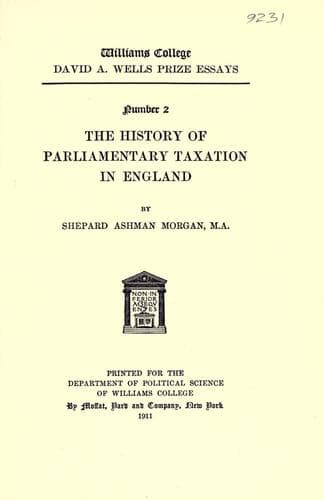
The History of Parliamentary Taxation in EnglandMorgan, Shepard Ashman
History
The History of Parliamentary Taxation in England
Morgan, Shepard Ashman
Taxation -- Great Britain; Taxation -- Great Britain -- History
Thus we observe that it was “expedient” for the lesser landholders to
be present in a Parliament which was called for the purpose of securing
the grant of a tax. The tone of the writ is most matter-of-fact, as
though the knights of the shire were considered scarcely less usual
attendants at Edward’s parliaments than the magnates themselves. That
the king “declared unto them certain of his business” and that they
proved amenable is exhibited by the fact that this Parliament granted
a fifteenth of temporal movables.[130]
The next event of importance witnessed the extension of the function
of levying taxes to the citizens and burgesses. By the fall of 1282
Edward found himself in financial difficulties. Since the Parliaments
of 1275 taxation had been very light. He had received in 1279 a scutage
of forty shillings on the fee on account of the Welsh war,[131] and he
received assistance from the clergy in 1279 and the years following.
Beside the income resulting from these grants, he still had his custom
on wool, but it was far from sufficient for his needs, and he had been
obliged to have recourse to the rigid enforcement of statutes, rigorous
application of writs, notably that of _Quo Warranto_,[132] and in 1278
he had adopted the expedient, in after time to be exercised frequently,
of compelling all who possessed £20 a year in lands to become knights,
and to pay the fee incidental to the attainment of knighthood.[133]
[Provincial assemblies at Northampton and York, 1283]
The Welsh war came on again in 1282 and added to the king’s
embarrassment. He was unwilling to call a Parliament and took the less
public but also less efficient means of negotiating with individuals
for money with which to carry on the war. He sent royal commissioners
abroad through the country who should plead the king’s necessity and
accept grants from sheriffs, bailiffs, and mayors as representing
their respective communities, and also from individual citizens and
countrymen upon their own behalf.[134] These private offerings tided
the king over his immediate necessities. Late in the fall, however, he
found his position untenable and was forced either to call a Parliament
or to adopt some effective substitute. Being at Rhuddlan, in the
center of hostile country, and having most of his barons with him, he
was obliged to formulate a new plan for the attainment of his end or
else to adopt existing machinery to his purposes. He sent out writs
on the 24th November bidding the sheriffs send representatives to two
provincial assemblies at Northampton or York, as the case might be, for
the 20th January following. The members were to include all those who
were capable of bearing arms, and who held lands to the annual value of
£20, not already with the army; four knights from each county having
full power for the community of the county; two men from each city,
borough, and market town, having like power for the community of the
Public-domain text, read in full here on John Shaqi.
Reviews
Reviews
No reviews yet
Be the first to share your thoughts on this work.
Elsewhere in the archive
Join the Discussion
Join the discussion
Sign in to leave a comment or review.
Sign InorCreate an account