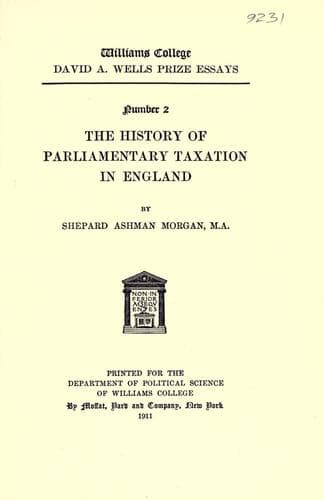
The History of Parliamentary Taxation in EnglandMorgan, Shepard Ashman
History
The History of Parliamentary Taxation in England
Morgan, Shepard Ashman
Taxation -- Great Britain; Taxation -- Great Britain -- History
“Behold,” he cried, his voice choked with tears, “I am going to expose
myself to danger for your sakes; I pray you, if I return, receive me
as you have me now, and I will restore to you all that has been taken.
But if I return not,” and at this he brought forward his son, the young
Edward, who was standing near him on the platform, “crown my son as
your king.”[171] The people threw up their caps and promised fealty to
the king. The archbishop declared his resolve to be faithful.
[His financial expedients]
But neither the reconciliation with the church nor the adherence of
the London populace brought him money, and in so far as advantage was
reckoned in terms of shillings, Edward was no better off than before
his council of the 7th July. He had recourse to the old expedient
of individual negotiation. He consulted in a private audience the
chief men still remaining of those who had gathered for the military
levy; he assumed their ability to grant taxes upon the analogy of a
Parliament, an assumption scarcely reasonable in view of their depleted
numbers. Notwithstanding the fact that Earls Roger and Humfrey remained
obdurate, such of the barons and knights as were there granted an
eighth and the citizens and burghers a fifth, on the somewhat hazy
understanding that the king should confirm the charters. Edward on the
30th July gave orders for the collection of the tax and issued writs
for the seizure of 8000 sacks of wool, for which the merchants received
tallies as a record of credit at the exchequer.[172]
[The barons’ grievances]
Public-domain text, read in full here on John Shaqi.
Reviews
Reviews
No reviews yet
Be the first to share your thoughts on this work.
Elsewhere in the archive
Join the Discussion
Join the discussion
Sign in to leave a comment or review.
Sign InorCreate an account