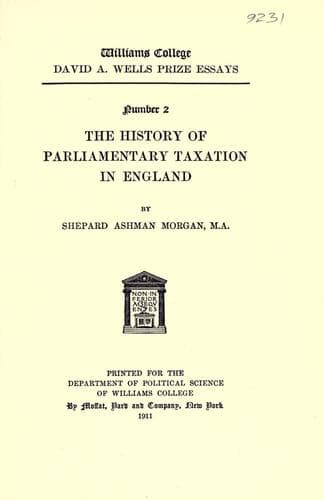
The History of Parliamentary Taxation in EnglandMorgan, Shepard Ashman
History
The History of Parliamentary Taxation in England
Morgan, Shepard Ashman
Taxation -- Great Britain; Taxation -- Great Britain -- History
Then he went down to the coast and prepared to embark. Putting great
faith in the continued support of the people, he addressed to them
an eloquent plea for loyalty to the crown as against the barons. He
spoke of the exactions of money to which they had been subjected,
and declared that, severe as was the pain which had been inflicted
upon the people, equally great was his own distress; that the money
had been spent for “le commun profit du reaume, pur son pople honyr
et destruyre.”[173] The barons, on the other hand, immediately came
forward with a list of grievances which they presented to the king,
complaining, amongst other things, of the aids, tallages, and prises
which the king had lately levied. So afflicted were they with “divers
tallages, aids, and prises,” such as those upon corn, oats, malt, wool,
hides, oxen, kine, and salt meat, that it would have been impossible
for them to equip for any foreign expedition. More than that, they
could make no grant of an aid, because of their great poverty following
the exaction of the aforesaid tallages and prises; indeed, there were
“many who had no sustenance, and who could not till their lands.” The
tax on wool was much too heavy, no less than 40_s._ on the sack; wool
comprised half the wealth of the nation, and the tax was equivalent
to a fifth part of the value of the whole land. Magna Carta and the
Charter of the Forest were both disregarded, and many acts were done
in defiance of them.[174]
[Edward embarks for Flanders]
Edward did not return a definite answer; the call to war sounded too
loudly. Before he embarked he issued orders for the collection of a
third of clerical temporalities in a most peremptory manner; on the
10th August the clergy had expressed hopes of being able to gain the
Pope’s permission to disregard the provisions of “Clericis laicos,”
but of late they had showed a disposition to stand with the baronage.
Finally, on the 22d August, Edward succeeded in getting up sail and
made for Flanders.
But he could not escape the issue. Almost before England had sunk below
his horizon Bohun and Bigod were at the Exchequer loudly protesting
against the collection of the aid which had been irregularly granted to
Edward five weeks previously. They went to the extreme of forbidding
the Barons of the Exchequer to proceed with their work of taking the
tax until Edward should make formal confirmation of the Charters.[175]
The Londoners forgot their loyalty to the king, and swore by the earls.
The young Prince Edward, afterward king, whom Edward had left as his
regent, tried to throw a dam across the swelling river by promising
that the eighth should not be taken into precedent.[176] This was
published in proclamation on the 28th August, but it availed nothing.
The fifth which had been asserted as owing from the cities and boroughs
was lost sight of.
Public-domain text, read in full here on John Shaqi.
Reviews
Reviews
No reviews yet
Be the first to share your thoughts on this work.
Elsewhere in the archive
Join the Discussion
Join the discussion
Sign in to leave a comment or review.
Sign InorCreate an account