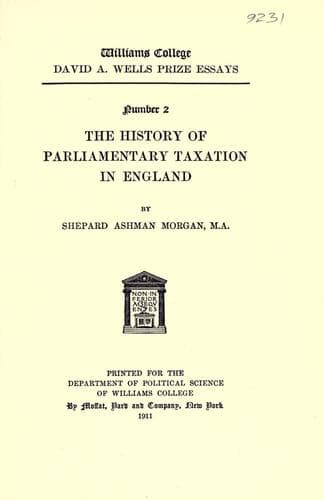
The History of Parliamentary Taxation in EnglandMorgan, Shepard Ashman
History
The History of Parliamentary Taxation in England
Morgan, Shepard Ashman
Taxation -- Great Britain; Taxation -- Great Britain -- History
Edward, two days before his departure for Flanders had sent out
summonses to a number of barons and knights to meet his son on the
8th September at Rochester. But before that date was reached, the
necessity for a full Council was apparent. Accordingly, on the 8th
September, messages were sent out which called most of the barons of
the royal party; on the 9th, Archbishop Winchelsey, the Constable and
the Marshal, were summoned,[177] and on the 15th letters were addressed
to the sheriffs ordering an election of knights of the shire.[178] No
representatives of the cities and boroughs or of the inferior clergy
were called.
[Principle that grants must await redress of grievances]
The Parliament was summoned for the octaves of St. Michael (the 6th
October), at London. The great nobles, coming with their train of armed
soldiers, both foot and horse, had command of the situation.[179]
They demanded that the young regent confirm Magna Carta and the
Charter of the Forest, together with certain supplementary articles.
Prince Edward, acting on the advice of his councillors, agreed,
and straightway on the 10th October, sent the Charters and the new
provisions to his father in Flanders for final confirmation. Nor was
that enough. “The earls,” says Bishop Stubbs, “took advantage of their
strength to force on the government the principle, which both before
and long after was a subject of contention among English statesmen,
that grievances must be redressed before supplies are granted.”[180]
The irregular and much disputed grant of an eighth they declared null,
and in place of it they substituted a ninth from such of the laity
as were in attendance, a grant in which the towns subsequently were
included. Here was one of the opening battles in the war which was to
decide whether or not Parliament, sitting guardian of the public purse,
could by reason of that guardianship, establish its control over the
executive as well as the legislative acts of the nation.
[Confirmation of the Charters]
The articles found the king at Ghent on the 5th November and he set his
name both to the Charters and to the provisions supplementary to them.
The difficulties with the barons thus concluded, it was not long before
the clerical atmosphere cleared also. On the 20th November, the clergy,
in response to a suggestion from Archbishop Winchelsey, evading the
letter of “Clericis laicos,” initiated a tax upon themselves, a fifth
from the northern province, and a tenth from the southern.[181] The
purpose of the levy was the defense of the realm against the Scots who
had again invaded the north.[182]
Public-domain text, read in full here on John Shaqi.
Reviews
Reviews
No reviews yet
Be the first to share your thoughts on this work.
Elsewhere in the archive
Join the Discussion
Join the discussion
Sign in to leave a comment or review.
Sign InorCreate an account