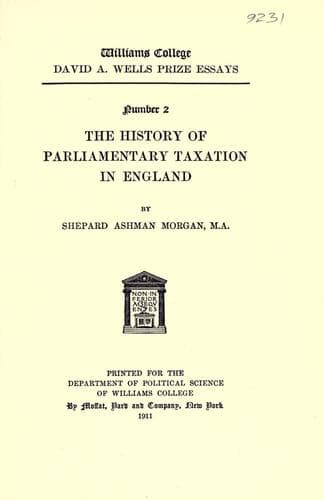
The History of Parliamentary Taxation in EnglandMorgan, Shepard Ashman
History
The History of Parliamentary Taxation in England
Morgan, Shepard Ashman
Taxation -- Great Britain; Taxation -- Great Britain -- History
Seizure of corn, wool, and leather was provided against, and the
maletolt was forever done away with. Humfrey Bohun and Roger Bigod
received pardon for themselves and their following for failing to serve
in the train of Edward when he went to Flanders.
_De tallagio non concedendo_ was denominated a statute in the Petition
of Right and declared to be such by decision of the judges, in the
Hampden case in 1637. In all probability, however, it is nothing but
the Latin abstract of Confirmatio Cartarum, included by Walter of
Hemingburgh in his narrative for the greater convenience of the reader,
together with a formal statement of the pardon of the two earls. That
Edward did not feel himself bound by the restrictions of the “Statute”
is shown by the fact that in 1304 he tallaged the towns and the royal
demesne. Furthermore, the nation seems at the time not to have regarded
the Chronicler’s articles as law, for they registered no complaint
against Edward’s tallage.[187]
The appearance of Confirmatio Cartarum marked a stage in the history
of parliamentary taxation. During the reigns of Henry III and Edward,
machinery was constructed which could carry out the chapters of Magna
Carta providing for taxation by assent. The Parliament of the three
estates, assembled for the purpose of meeting the pecuniary necessities
of the king, proved itself to be the easiest and most effective means
by which the whole nation could grant taxes. But the evolution from the
Commune Concilium, the rough prototype of Parliament, had scarcely gone
farther than to supply a convenient instrument of taxation. In 1297
every tax did not need the assent of Parliament as the prerequisite to
its levy; Confirmatio Cartarum was not all-inclusive. More than that,
the question was still undetermined as to whether the granting of
supplies should always wait upon redress of grievances. If Parliament
should maintain that principle in practice, then its hold would be
secure upon the executive. Power in 1297 was not far from a balance
between king and nation.
If the evolution of a government can ever be attributed to the
directing skill of man rather than to the slow weaving of events,
the construction for England of an engine of popular taxation can be
ascribed to Edward Plantagenet, and in less degree to the drafter of
the working plan, Simon de Montfort. Edward perceived the nation’s
problem and adapted such means as lay near his hand to its solution. So
it was that an assembly, not only of the magnates of the kingdom, but
of elected knights of the shire, of parish priests from the inferior
clergy, of merchant citizens and burgesses from the towns, came
together to provide in common for the common need.
V
TAXATION BY THE COMMONS 1297-1461
[Character of the period]
Public-domain text, read in full here on John Shaqi.
Reviews
Reviews
No reviews yet
Be the first to share your thoughts on this work.
Elsewhere in the archive
Join the Discussion
Join the discussion
Sign in to leave a comment or review.
Sign InorCreate an account