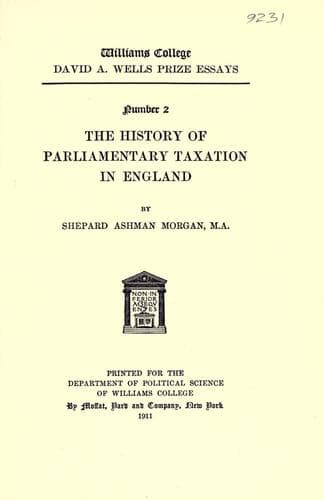
The History of Parliamentary Taxation in EnglandMorgan, Shepard Ashman
History
The History of Parliamentary Taxation in England
Morgan, Shepard Ashman
Taxation -- Great Britain; Taxation -- Great Britain -- History
THE years subsequent to 1297 up to the time of the Tudors comprise a
period of differentiation within Parliament itself. Save for the event
of the year 1340, when the statute was passed which completed the
movement punctuated by Confirmatio Cartarum, to the effect that every
form of taxation must have the sanction of Parliament in order to be
legal, the three centuries showed greater progress inside the walls of
Parliament than beyond them. Struggles there were in plenitude between
king and Parliament to secure adherence in practice to the theory
enunciated in 1340, but the great question was that of the ruling
power within Parliament. It is during this period that the Commons
come forward as the sole initiators of taxes, leaving to the Lords
merely the coördinate power of consent. In close interrelation with
this monopoly of power over the public purse, comes, in consequence
of the theory that supplies must wait upon redress of grievances, the
advance toward control by the House of Commons of the entire machinery
of government, legislative and executive.
It is a period of confusion and contradiction. Time and again
constitutional life seems to be dead. War, disputed succession to the
crown, tyranny, slip-shod government,--these and more tend to make
the years 1297-1461 a bundle of scenes ill-bound together. The Wars
of the Roses, the struggles with France for various causes and with
varied consequences, the doting of monarchs upon foreign favorites,
all contribute toward popular distraction from that interest in
government, that keen hostility to maladministration, which makes
for constitutional progress. There was no leader to prick the public
conscience; no Simon de Montfort or Edward Plantagenet to inaugurate
reforms in the great matters of government.
[The Parliament of Lincoln, 1301]
Public-domain text, read in full here on John Shaqi.
Reviews
Reviews
No reviews yet
Be the first to share your thoughts on this work.
Elsewhere in the archive
Join the Discussion
Join the discussion
Sign in to leave a comment or review.
Sign InorCreate an account