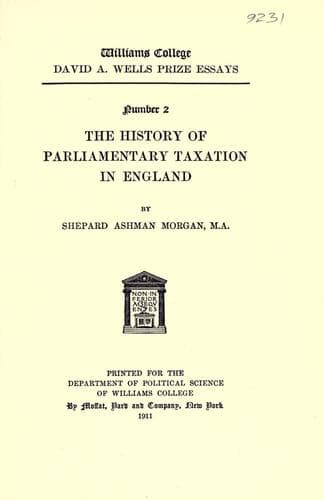
The History of Parliamentary Taxation in EnglandMorgan, Shepard Ashman
History
The History of Parliamentary Taxation in England
Morgan, Shepard Ashman
Taxation -- Great Britain; Taxation -- Great Britain -- History
The effect upon the people was immediate; unable to sympathize with
the project of importing skilled labor and seeing only the curtailment
in profits normally accruing from their chief article of export, they
were led almost to the point of revolt. The Parliament which met in
September 1339, in answer to the general cry for reform, brought
forward measures aimed to allay the popular irritation. The barons made
the curious grant of “the tenth sheaf, the tenth lamb, and the tenth
fleece, payable in two years,” and they “willed that the maletolt of
wool lately levied afresh, be entirely removed and held to the old
rate.”[217] The knights and burgesses, questioning their ability to
grant money to the king without first consulting their constituents,
desired the matter deferred to a subsequent Parliament. They mentioned
six grievances upon which they demanded redress. They asked release
from the customary aids and prises, and “that the maletolt of wool and
lead be taken as of old, for that the same is now increased without the
assent of Parliament.”[218] The new Parliament, in accordance with the
will of the knights and burgesses, was summoned for the 20th January,
1340.
At this session no new legislation was undertaken. Edward was
abroad and his absence discouraged the members from enunciating new
principles. They showed themselves, however, sympathetic with the royal
necessities. The lords again offered the tenth sheaf, the tenth fleece,
and the tenth lamb; the commons granted 30,000 sacks of wool, on the
condition of the royal acceptance of certain articles drawn by them,
and in case their reforms were not favored by the king, they made a
free gift of 2500 sacks of wool.[219] Edward called a new Parliament
which met the 29th March, there being in attendance a large body of
merchants. The prelates, barons, and knights made a gift of the ninth
sheaf, fleece, and lamb in complement to the baronial tenth of the
previous January, and the towns gave a ninth of movables; a fifteenth
from the rest of the nation, such as had no wool and yet were not
townsfolk, completed the grant, save for a custom on each sack of
wool, on every 300 woolfells, and on every last of leather, of forty
shillings.[220] But the gifts were conditional; the king was to accept
the articles prepared by the commons. Being amenable to their will,
he referred the petitions to a committee, part of which was selected
by the commons themselves, with the understanding that it should draw
up statutes embracing such of the matters prayed for as were of a
permanent character.
[Statutory abolition of the maletolt and of all unauthorized
taxation]
Public-domain text, read in full here on John Shaqi.
Reviews
Reviews
No reviews yet
Be the first to share your thoughts on this work.
Elsewhere in the archive
Join the Discussion
Join the discussion
Sign in to leave a comment or review.
Sign InorCreate an account