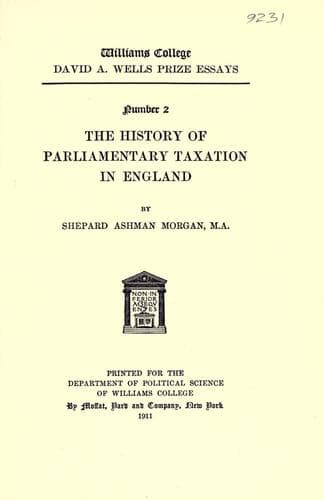
The History of Parliamentary Taxation in EnglandMorgan, Shepard Ashman
History
The History of Parliamentary Taxation in England
Morgan, Shepard Ashman
Taxation -- Great Britain; Taxation -- Great Britain -- History
But the regulation of the relations between king and merchant denizens,
and incidentally through them, his relations (aside from the New
Customs) with the aliens, is not so briefly told. Throughout the reign
of Edward III the question was being quietly fought out as to whether
or not the king might tamper with the wool customs irrespective of
parliamentary sanction. In 1332 Edward issued an ordinance which
provided for the collection of a subsidy on the wool of denizens; the
rate was to be half a mark on the sack and 300 woolfells, and twenty
shillings on the last of leather. A year later on the 30th June, 1333,
Edward recalled his ordinance, but he did not relinquish his grasp
upon the customs; by negotiation with the merchants, he received ten
shillings on the sack and 300 woolfells and a pound on the last. In
order to bolster up the legality of the proceeding, he issued a royal
ordinance to the same effect.[212]
[The wool customs]
In August of the year 1336, when the king’s arms were meeting with
great success on the northern border, Edward, confident in his
popularity, sent out royal letters forbidding the export of wool.[213]
Parliament met at Nottingham the following month full of pride in the
military prowess of the king, and granted him liberal aids. Not only
did the barons and knights contribute a twentieth, the towns a tenth,
the clergy a sixth, but the merchants, who were at this moment, so it
appeared, on the verge of attaining to the dignity of a fourth estate
in Parliament, granted him forty shillings on the sack of wool; and
the foreign merchants were to pay an additional twenty shillings.[214]
In the hope that its action would encourage the domestic manufacture
of cloth, Parliament in March, 1337, passed a statute forbidding
the exportation of wool, and offering foreign operatives special
inducements to settle in England.[215] The embargo was to continue
until the king and his Council should decide otherwise. Thus empowered,
Edward and his Council issued an ordinance imposing upon denizens a
custom of £2 on the sack and on 300 woolfells, and £3 on the last of
leather; the unfortunate aliens were to pay double.[216]
Public-domain text, read in full here on John Shaqi.
Reviews
Reviews
No reviews yet
Be the first to share your thoughts on this work.
Elsewhere in the archive
Join the Discussion
Join the discussion
Sign in to leave a comment or review.
Sign InorCreate an account