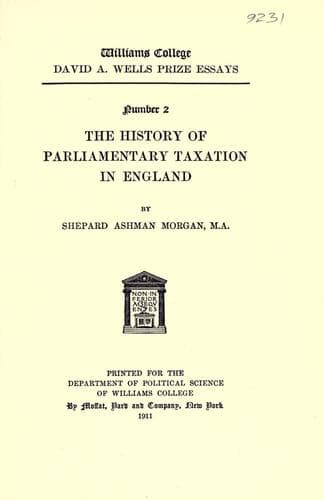
The History of Parliamentary Taxation in EnglandMorgan, Shepard Ashman
History
The History of Parliamentary Taxation in England
Morgan, Shepard Ashman
Taxation -- Great Britain; Taxation -- Great Britain -- History
Side by side with the power to grant taxes was growing up the faculty
for supervising the expenditure of money so raised. As far back as the
second decade of the reign of Henry III, in 1237, William of Ralegh
had suggested to the Commune Concilium that it appoint a committee
with whom the proceeds of a grant be deposited and by whom the money
be expended; that the suggestion was not taken was owing, perhaps, to
the ignorance of the baronage. Edward I was too strong to permit of
being so controlled, and under Edward II the whole power of the crown
was for a time delegated to others; in neither reign was the principle
of appropriation of supplies definitely put forward. But in the time of
Edward III, owing doubtless to the vast sums thrown into his bottomless
war chest, Parliament began to demand a voice in the disposition of
the public funds. In 1340, as we have seen, it was denominated in the
statute that the “profits of the said realm of England shall be put
and spent upon the maintenance of the safeguard of our said realm of
England, and of our wars.”[235] The grants of 1346 and 1348, in so
far as they accrued from the northern counties, were to be applied to
defend the border against the Scots,[236] and in 1353 a subsidy on wool
was granted to be applied solely for the purposes of the war.[237]
[Examination of accounts]
Whether or not the money was actually applied according to the
direction of Parliament was another matter. Efforts to ensure the
carrying out of the parliamentary will were begun as early as 1340. In
that year a committee of lords and commons was appointed to examine the
accounts of William de la Pole and the other collectors of the last
subsidy.[238] In 1341 the Rolls of Parliament have it that “the great
men and commons of the land pray, for the common profit of the king
and of themselves, that certain persons be deputed by commission to
audit the accounts of all those who have received the wool of our said
lord, or other aid granted to him; and also of those who have received
and paid out his money, as well beyond the seas as in the realm from
the commencement of his war until now; and that the rolls and other
remembrances, obligations, and other things made abroad be delivered
into the chancery, to be enrolled and recorded, just as was wont to
be done heretofore.”[239] To the petition the royal response ran: “It
is the king’s pleasure that this be done by good men deputed for the
purpose, with the addition that the treasurer and the chief baron be
of the number; and that it be done concerning this as it was heretofore
ordained; and that the lords be chosen in this Parliament. And also
that all rolls, remembrances, and obligations made beyond the sea, be
delivered into the chancery.”[240]
Public-domain text, read in full here on John Shaqi.
Reviews
Reviews
No reviews yet
Be the first to share your thoughts on this work.
Elsewhere in the archive
Join the Discussion
Join the discussion
Sign in to leave a comment or review.
Sign InorCreate an account