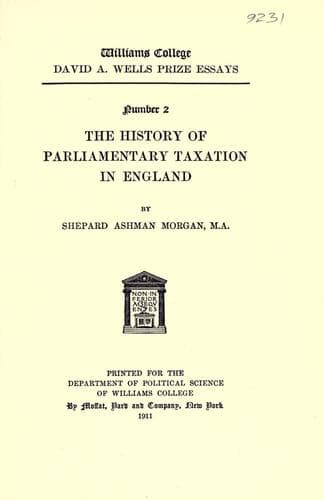
The History of Parliamentary Taxation in EnglandMorgan, Shepard Ashman
History
The History of Parliamentary Taxation in England
Morgan, Shepard Ashman
Taxation -- Great Britain; Taxation -- Great Britain -- History
There is not much reason to suppose that Edward adhered to this promise
better than he held to others of a similar character, save that there
appears no complaint from Parliament until the last year of his reign.
In 1377, in voicing the demand of Peter de la Mare, the commons in the
Good Parliament petitioned “that it may please our lord the king to
name two earls and two barons, of those who shall seem to him best, who
shall be guardians and treasurers as well of this subsidy now granted
and of the subsidy which the clergy of England is yet to grant to
the king our lord, as of the subsidy of wool, leather, and woolfells
granted in the last Parliament.”[241] The lords so chosen were to be
sworn before the commons, and were to expend the subsidies “for the
said wars and for no other work.” The high treasurer of England was
to have nothing to do with it in anywise whatsoever. Decisive action,
however, waited upon the next reign.
[Death of Edward III, 21st June, 1377]
The long life of Edward III came to an end on the 21st June, 1377. His
was a reign which had seen much war, much poverty, much famine, and
worse than these, the Great Plague. The time was not well designed,
so it would seem, for constitutional advance, yet in the direction of
parliamentary taxation, the progress was marked. To be sure, Parliament
had not dared to come into open combat with the king, and had, in order
to preserve its theoretical power, been many times obliged to sanction
a tax after it had been levied. Thus did Edward play with Parliament
throughout the argument over the wool tax, yet the nation did secure
the enunciation of complete parliamentary control over the levying of
taxes of every description in the sweeping legislation of 1340.
But Parliament had shown a disposition to reach out after powers
which its predecessors in some instances had exercised and in others
foreshadowed. The history of the wool customs shows this if it shows
nothing else, that Parliament was inclined to make supply wait upon
redress of grievances; that the inclination was not a determination
was owing to the fact of Edward’s wars; withholding supply would wreck
English military prestige far more quickly than the arms of France. Yet
the time was not far distant when the grant would be reserved until the
end of the session, and thus secure the redress of grievances before
the granting of a supply. By other means, also, Parliament was reaching
out to control the executive. By appropriating money for particular
purposes, to which expenditure should be limited, and by demanding
an audit of accounts to insure adherence to those limitations, the
representatives of the nation were securing for it the control of the
public purse, not only in the department of income but of outlay.
[Separate sessions of the houses]
Public-domain text, read in full here on John Shaqi.
Reviews
Reviews
No reviews yet
Be the first to share your thoughts on this work.
Elsewhere in the archive
Join the Discussion
Join the discussion
Sign in to leave a comment or review.
Sign InorCreate an account