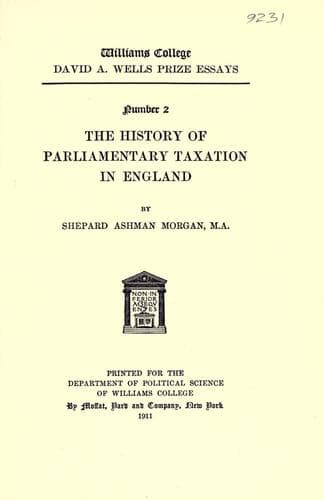
The History of Parliamentary Taxation in EnglandMorgan, Shepard Ashman
History
The History of Parliamentary Taxation in England
Morgan, Shepard Ashman
Taxation -- Great Britain; Taxation -- Great Britain -- History
Furthermore, at the session of 1533-4, Parliament had laid very
definite restrictions upon the clergy in the matter of regular
taxation.[288] Since the early part of the fourteenth century, indeed,
almost since the beginning of Parliament itself, the lesser clergy
had attended the sessions with great irregularity, and had voted
their taxes for the most part in provincial assemblies. Now, however,
came the general prohibition that the clergy should not enact or
execute ordinances binding upon themselves without the king’s license
and without his approval when once they were made. Included within
the meaning of this prohibition was the granting of taxes. From
thenceforward until the time of Charles II, when, without any special
enactment but by simple process of evolution, the clergy began to be
taxed in the same manner and according to the same rate as the laity,
clerical grants were submitted to Parliament for confirmation.
Henry VIII died in 1547. Notwithstanding the heavy taxation,
parliamentary and unparliamentary, which had been exacted during his
reign, he remained popular with the great majority of his subjects
to his death. His many vices were counterbalanced by his successful
wars, the heavy taxation by the growing trade of England, and his
semi-independence of Parliament by most efficient administration.
[Elizabeth’s accession, 1558]
After the lapse of eleven years, which in so far as they concern the
evolution of the taxing power of Parliament, composed in effect an
interregnum, Elizabeth succeeded to the throne of England. Elizabeth’s
government was a despotism and was illegal; but it was so by
sufferance, not because the nation was ignorant of its true character
or because the people were unable to control it. When in later years
the attempt was made to create a despotism against the voice of the
people, the result was a Cromwell and his Charles I. Queen Elizabeth
was loved by her subjects and they put their trust in her. The sympathy
existing between queen and people could not be illustrated better
than by the following anecdote, which suggests that under her rule
benevolences were really made with the good will of the givers.
The queen, being at Coventry, is presented by the mayor with a purse
heavily filled with gold.
“I have few such gifts, Mr. Mayor,” says the queen; “it is a hundred
pounds in gold!”
“Please, your grace,” the mayor answers, “it is a great deal more we
give you.”
“What is it?” asks the queen.
“It is,” the mayor replies, “the hearts of your loving subjects.”
And the queen makes answer, “We thank you, Mr. Mayor; it is a great
deal more indeed.”[289]
[Liberality of Elizabeth’s Parliaments. Her
extra-Parliamentary exactions]
Public-domain text, read in full here on John Shaqi.
Reviews
Reviews
No reviews yet
Be the first to share your thoughts on this work.
Elsewhere in the archive
Join the Discussion
Join the discussion
Sign in to leave a comment or review.
Sign InorCreate an account