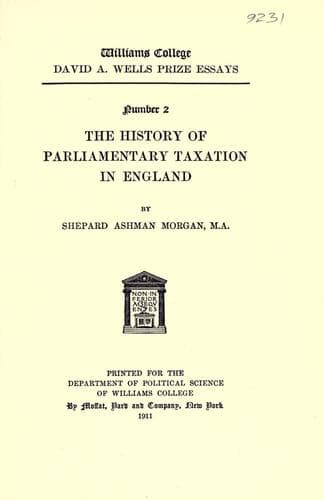
The History of Parliamentary Taxation in EnglandMorgan, Shepard Ashman
History
The History of Parliamentary Taxation in England
Morgan, Shepard Ashman
Taxation -- Great Britain; Taxation -- Great Britain -- History
But Henry had other strings to his bow, and of these the forced
loan was one which served him well. In 1522 commissioners were
appointed throughout the kingdom to ascertain the value of every
man’s possessions and to require a certain part for the king, on
the understanding that they be repaid out of the grants from the
next Parliament. The promise of repayment was under the king’s privy
seal.[281] In 1544, forced loans were again exacted, this time from
all persons rated at £50 and more per annum. Parliament, subservient
to the king, far from protesting because of these arbitrary demands
upon the pockets of the people, in two instances released the king
from liability to payment. In 1529, Parliament “for themselves and all
the whole body of the realm which they represent, freely, liberally,
and absolutely, give and grant unto the King’s highness ... all and
every sum and sums of money which to them and every of them, is,
ought, or might be due by reason of any money ... advanced or paid
by way of trust or loan.”[282] This caused much murmuring, but, as
Hall’s Chronicle rightly puts it, “Ther was no remedy.” In 1544 a
similar act of a servile Parliament not only gives the king the funds
borrowed under the forced loan of 1542, but commands the refunding of
sums already paid by him to his creditors in discharge of debts so
incurred.[283]
[Profits of the English Reformation]
The Reformation in England redounded to the financial benefit of the
Crown. In 1532 the clergy were relieved by act of Parliament from
the payment of annates or first fruits, the sums which the ordaining
authorities exacted from those accorded any preferment in the church,
and which amounted sometimes to as much as a year’s income from
the benefice. The exactions were denounced as having risen by “an
uncharitable custom, grounded upon no just or good title,” and through
them “great and inestimable sums of money have been daily conveyed out
of this realm, to the impoverishment of the same, and to the advantage
of the court of Rome.”[284] The same Parliament, meeting for its fifth
session on the 15th January, 1533-4, reënacted the statute without
the contingencies which had conditioned the other.[285] Closely
following came a statute that deprived the Pope of his petty exactions
which for generations he had drawn from the English Church. Thus were
discontinued peter-pence, procurations, fruits, fees for dispensations,
licenses, faculties and grants.[286] The sixth session of this
Parliament, meeting at the end of the year 1534, turned the procedure
into comedy by attaching to “the King’s imperial crown forever” the
first-fruits and tenths of the annual income of all ecclesiastical
benefices, the very payments which it had declared to be in conformity
with an “uncharitable custom.”[287]
[Parliament the confirming authority in clerical grants]
Public-domain text, read in full here on John Shaqi.
Reviews
Reviews
No reviews yet
Be the first to share your thoughts on this work.
Elsewhere in the archive
Join the Discussion
Join the discussion
Sign in to leave a comment or review.
Sign InorCreate an account