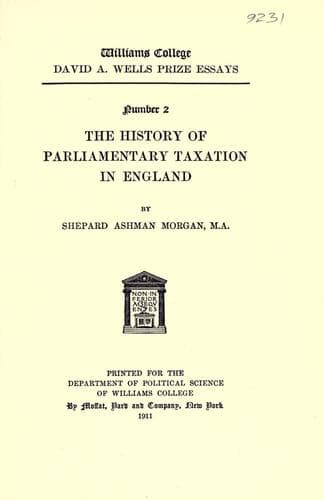
The History of Parliamentary Taxation in EnglandMorgan, Shepard Ashman
History
The History of Parliamentary Taxation in England
Morgan, Shepard Ashman
Taxation -- Great Britain; Taxation -- Great Britain -- History
Toward the close of the reign of Elizabeth there was another evidence
of the growing realization on the part of the commons that their powers
were not to be tampered with. In this instance, the vindication was not
against the prerogative of the sovereign, but against an arrogation of
power on the part of the House of Lords. The incident was based upon
the decreasing liberality of the commons in the years after the Armada.
They had risen nobly to the defense of the nation against the peril,
but, with the passing of it, their generosity had faded. In 1593, it
was represented that, though the queen had spent upon the war some
£1,030,000 of her own, the grants of the commons persisted in being
inadequate. A message was sent down from the lords which remarked upon
the need for a supply and requested the appointment of a committee of
conference. Sir Robert Cecil, reporting from the committee, stated
that the lords would assent to no smaller grant than three entire
subsidies.[291] The commons, on the other hand, had shown a disposition
to grant no more than two. Francis Bacon stated the issue. He yielded
to the subsidy, “but disliked,” he said, “that this house should join
with the upper house in granting it. For the custom and privilege of
this house hath always been, first to make offer of the subsidies from
hence, then to the upper house; except it were that they present a bill
unto this house, with desire of our assent thereto, and then to send
it up again.”[292] The commons refused to have further conference
with the lords, so determined were they to vindicate their right to
originate money bills, by the vote 217 to 128. Notwithstanding this
scrupulous adherence to principle, they accepted the suggestion and
came forward with a grant of three subsidies, six tenths and six
fifteenths.
The death of Queen Elizabeth in 1603, brought to an end the Tudor
period and cleared the throne for James Stuart. The Tudor era was one
which can be passed lightly over in a strict account of progress toward
parliamentary supremacy in taxation. In such a study the period of the
Tudors is a bywater. Yet the fact that the principles enunciated in
the years prior to their accession stayed alive despite the attacks of
Tudor subtlety, points to a vitality sufficient to down the Stuarts,
and to establish permanent parliamentary control over the laying of
taxes.
VII
THE STUARTS: 1603-1689
[Divine right as against Parliamentary supremacy]
Public-domain text, read in full here on John Shaqi.
Reviews
Reviews
No reviews yet
Be the first to share your thoughts on this work.
Elsewhere in the archive
Join the Discussion
Join the discussion
Sign in to leave a comment or review.
Sign InorCreate an account