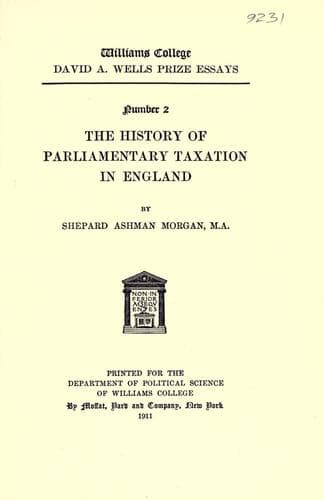
The History of Parliamentary Taxation in EnglandMorgan, Shepard Ashman
History
The History of Parliamentary Taxation in England
Morgan, Shepard Ashman
Taxation -- Great Britain; Taxation -- Great Britain -- History
THE theory of divine right, by which the Stuarts laid claim to a
sovereignty as irresponsible as it was far-reaching, in practice came
into direct conflict with another theory which had been taking shape
for some four centuries, the supremacy of Parliament. In the field
of taxation the issue is scarcely less apparent. Parliament asserted
the supremacy of its will over all kinds of taxes, indirect as well
as direct. The crown, on the other hand, hesitating to close with the
representatives of the people over a question of their authority in
direct taxation, maintained that unchecked royal power extended to
indirect taxes, including duties at the ports. Furthermore, the crown,
whenever occasion arose, sought to elude the hold of Parliament upon
direct taxation, by resorting to the familiar resources of benevolences
and the sale of monopolies, and at last to the levy of ship money.
With the issue so direct, the great question was that of strength.
Should the crown with its array of adherents, upholding as their ideal
the perfect exercise of the royal prerogative, prove itself stronger
than the House of Commons? Or were the commons to prevail, standing
for the principle that the representatives of the people sitting in
Parliament should have complete control over the public purse?
[James I, 1603-1625]
James Stuart, swollen with intellectual pride, was, according to the
Duc de Sully, “the wisest fool in Europe.” Worse than his vanity were
his unsteadiness and his insincerity, traceable, perhaps, to the
Italian-Gallic stock whence he was bred.[293] Divine right, a doctrine
by its nature offensive to Englishmen, was in him doubly hateful
because he was not born king, but was proclaimed by the Council, an act
ratified, however, by popular voice, and subsequently acquiesced in by
Parliament.[294] In the matter of religion, he was not more agreeable;
suspected at times of plots to further Roman Catholicism, he assumed
toward the Puritans especial animosity, they standing in his mind not
so much as preachers of religion as propagandists of republicanism.
[James I dictates the composition of the Commons, 1604]
Public-domain text, read in full here on John Shaqi.
Reviews
Reviews
No reviews yet
Be the first to share your thoughts on this work.
Elsewhere in the archive
Join the Discussion
Join the discussion
Sign in to leave a comment or review.
Sign InorCreate an account