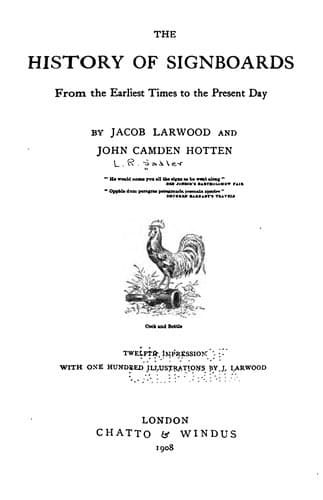
The History of Signboards, from the Earliest times to the Present DayHotten, John Camden
History
The History of Signboards, from the Earliest times to the Present Day
Hotten, John Camden
Inn signs -- England -- History; Signs and signboards -- History
Sometimes we meet with the King’s or Queen’s Arms in very odd
combinations; thus in the reign of Queen Anne there was a QUEEN’S ARMS
AND CORNCUTTER[131] in King Street, Westminster; the sign of Thomas
Smith, who, according to his handbill, (in the Bagford collection,)
had, “by experience and ingenuity learnt the art of taking out and
curing all manner of corns without any pain;” he also sold “the
famoustest ware in all England, which never fails curing the toothache
in half an hour.” It was customary with those who were “sworn servants
to his Majesty,”--_i.e._, who had the lord chamberlain’s diploma, to set
up the royal arms beside their sign. The said Thomas, however, does not
appear to have had this honour, for not a word about it is mentioned in
his bill, so that he must have set up the Queen’s Arms merely to blind
the public. The name of the person who filled the important office of
corncutter to Queen Anne, I am afraid is lost to posterity, but, _en
revanche_, we know who drew King Charles II.’s teeth, for the Rev. John
Ward has recorded in his Diary.[132] “Upon a sign about Fleetbridge this
is written,--‘Here lives Peter de la Roch and George Goslin, both which,
and no others, are sworn operators to the king’s teeth.’”
Royal badges, and the supporters of the arms of various kings, were in
former times largely used as signs. The following is a list of the
supporters:--
RICHARD II., Two Angels, (blowing trumpets.)
HENRY IV., Swan and Antelope.
HENRY V., Lion and Antelope.
HENRY VI., Two Antelopes.
EDWARD IV., Lion and Bull.
EDWARD V., Lion and Hind.
RICHARD III., Two Boars.
HENRY VII., Dragon and Greyhound.
HENRY VIII., Lion and Dragon.
EDWARD VI., Lion and Dragon.
MARY, Eagle and Lion.
ELIZABETH, Lion and Dragon.
JAMES I., Lion and Unicorn, which have continued ever since.
Of early royal badges an interesting list occurs in Harl. MS., 304, f.
12:--
“King Edward the first after the Conquest, sonne to Henry the third,
gave a Rose gold, the stalke vert.
“King Edward the iij gave a lyon in his proper coulor, armed azure
langued or. The oustrich fether gold, the pen gold, and a faucon in
his proper coulor and the Sonne Rising.
“The prince of Wales the ostrich fether pen and all arg.
“Queen Philipe, wyff of Edward the iij^{d}. gave the whyte hynd.
“Edmond, Duk of York, sonne of Edward the iij, gave the Faucon arg.
and the Fetterlock or.
“Richard the second gave the White hart, armed, horned, crowned or,
and the golden son.
“Henry, sonne to the Erl of Derby, first Duk of Lancaster, gave the
red rose uncrowned, and his ancestors gave the Fox tayle in his prop.
coulor and the ostrich fether ar. the pen ermyn.
“Henry the iiij gave the Swan ar. and the antelope.
“Henry the v gave the Antelope or, armed, crowned, spotted (?) and
horned gold and the Red Rose oncrowned and the Swan silver, crown and
collar gold, by the Erldom of Herford.
Public-domain text, read in full here on John Shaqi.
Reviews
Reviews
No reviews yet
Be the first to share your thoughts on this work.
Elsewhere in the archive
Join the Discussion
Join the discussion
Sign in to leave a comment or review.
Sign InorCreate an account