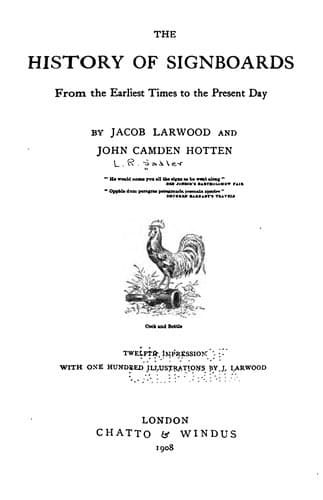
The History of Signboards, from the Earliest times to the Present DayHotten, John Camden
History
The History of Signboards, from the Earliest times to the Present Day
Hotten, John Camden
Inn signs -- England -- History; Signs and signboards -- History
In 1568 the prizes of the first lottery held in England were exhibited
at the Queen’s Arms in Cheapside, the house of Mr Dericke, goldsmith to
Queen Elizabeth. There were no blanks, and the prizes consisted of ready
money, and “certain sorts of merchandises having been valued and
prized.” It had 400,000 lots of 10s. each, and the profits were to go
towards repairing the havens of the kingdom. The drawing was at first
intended to have taken place at Dericke’s house, but finally was done at
the west door of St Paul’s. The programme of this lottery, printed by
Binneman, was exhibited to the Antiquarian Society by Dr Rawlinson in
1748. The next lottery was in 1612. It was drawn on the same plan, and
granted by King James, as a special favour, for the establishment of
English colonies in Virginia. Thomas Sharpley, a tailor, had the chief
prize, which consisted of £4000 of “fair plate.”
“On Friday, April 6,” (1781) says Boswell,[129] “Dr Johnson carried me
to dine at a club, which, at his desire, had been lately formed at the
Queen’s Arms in St Paul’s Churchyard. He told Mr Hoole that he wished to
have a City-club, and asked him to collect one; but, said he, don’t let
them be patriots. The company were that day very sensible well-behaved
men.” This same tavern was also patronised by Garrick. “Garrick kept up
an interest in the city by appearing about twice in a winter at Tom’s
coffeehouse in Cornhill, the usual rendezvous of young merchants at
Changetimes; and frequented a club established for the sake of his
company at the Queen’s Arms Tavern in St Paul’s Churchyard, where were
used to assemble Mr Samuel Sharpe, the surgeon; Mr Paterson, the City
solicitor; Mr Draper, the bookseller; Mr Clutterbuck, a mercer; and a
few others: they were none of them drinkers, and in order to make a
reckoning, called only for French wines. These were his standing counsel
in theatrical affairs.”[130]
Public-domain text, read in full here on John Shaqi.
Reviews
Reviews
No reviews yet
Be the first to share your thoughts on this work.
Elsewhere in the archive
Join the Discussion
Join the discussion
Sign in to leave a comment or review.
Sign InorCreate an account