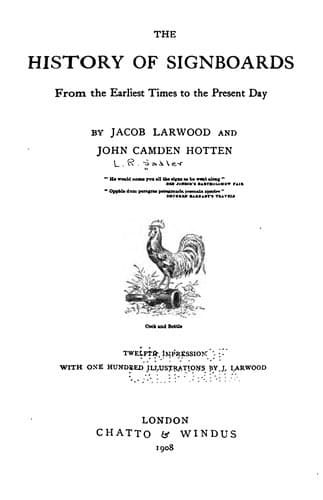
The History of Signboards, from the Earliest times to the Present DayHotten, John Camden
History
The History of Signboards, from the Earliest times to the Present Day
Hotten, John Camden
Inn signs -- England -- History; Signs and signboards -- History
_Notes and Queries_ says:--“I think the sign was not taken down till
after 1795, as I have a recollection of having passed under it when a
boy, in going from Norwich to Ipswich.” We obtain full details of this
wonderful erection from an engraving made in 1740, entitled:--
“The North East side of y^{e} sign of y^{e} White Heart at Schoale Inn
in Norfolk, built in the year 1655 by James Peck, a merchant of
Norwich, which cost £1057. Humb^{ly} Dedicated to James Betts, Gent.,
by his most ob^{t} serv^{t}, Harwin Martin.”
The sign passed over the road, resting on one side on a pier of
brickwork, and joined to the house on the other; its height was
sufficient to allow carriages to pass beneath. Its ornamentation was
divided into compartments, which contained the following subjects
according to the numbers in the engraving:--1. Jonah coming out of the
fish’s mouth. 2. A Lion supporting the arms of Great Yarmouth. 3. A
Bacchus. 4. The arms of Lindley. 5. The arms of Hobart. 6. A Shepherd
playing on his pipe. 7. An Angel supporting the arms of Mr Peck’s lady.
8. An Angel supporting the arms of Mr Peck. 9. A White Hart [the sign
itself] with this motto,--“IMPLENTUR VETERIS BACCHI PINGUISQUE FERINÆ.
ANNO DOM. 1655.” 10. The arms of the Earl of Yarmouth. 11. The arms of
the Duke of Norfolk. 12. Neptune on a Dolphin. 13. A Lion supporting the
arms of Norwich. 14. Charon carrying a reputed Witch to Hades. 15.
Cerberus. 16. A Huntsman. 17. Actæon [addressing his dogs with the words
“ACTÆON EGO SUM, DOMINUM COGNOSCITE VESTRUM.”] 18. A White Hart couchant
[underneath, the name of the maker of the sign, _Johannes Fairchild,
struxit_.] 19. Prudence. 20. Fortitude. 21. Temperance. 22. Justice. 23.
Diana. 24. Time devouring an infant [underneath, “TEMPUS EDAX RERUM.”]
25. An Astronomer, who is seated on a “circumferenter, and by some
chymical preparations is so affected that in fine weather he faces that
quarter from which it is about to come.” There is a ballad on this sign
in “Songs and other Poems,” by Alexander Brome, Gent. London, 1661, p.
123.
This herd of white harts has led us over a large tract of ground, but we
will now return to other royal badges, and note the HAWK AND BUCKLE,
which occurs in Wrenbury, Nantwich, Cheshire; Etwall, Derby; and various
other places. This is simply a popular rendering of the Falcon and the
Fetterlock, one of the badges of the house of York. The HAWK AND BUCK,
which appears to be only another version of the last corruption, occurs
at Pearsly Sutton Street, St Helens, Lancashire; the FALCON AND
HORSE-SHOE, a sign in Poplar in the seventeenth century, (_see_ Trades’
Tokens,) may have had the same origin, whilst the BULL AND STIRRUP, in
Upper Northgate, Chester, probably comes from the Bull and Fetterlock,
another combination of badges of the house of York.
Public-domain text, read in full here on John Shaqi.
Reviews
Reviews
No reviews yet
Be the first to share your thoughts on this work.
Elsewhere in the archive
Join the Discussion
Join the discussion
Sign in to leave a comment or review.
Sign InorCreate an account