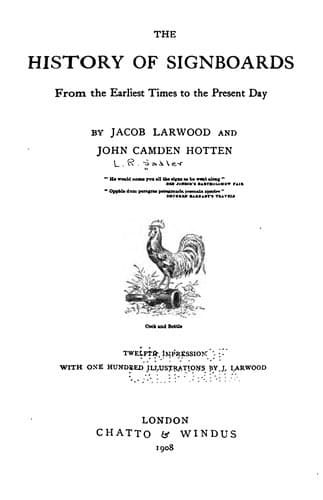
The History of Signboards, from the Earliest times to the Present DayHotten, John Camden
History
The History of Signboards, from the Earliest times to the Present Day
Hotten, John Camden
Inn signs -- England -- History; Signs and signboards -- History
From this family are also derived the BLUE BOAR and the WHITE BOAR. One
of the badges of Richard, Duke of York, father of Edward IV., was “a
blewe Bore with his tuskis and his cleis and his membres of gold.”[143]
The heraldic origin of this sign, of which there are still innumerable
instances all over England, is now so completely lost sight of, that in
many places it passes under the ignoble appellation of the BLUE PIG.
The WHITE BOAR was the popular sign in Richard the Third’s time, that
king’s cognizance being a boar passant argent, whence the rhyme which
cost William Collingborne his life:--
“The Cat, the Rat, and Lovell our Dogge,
Rulen all England vnder _an Hogge_.”[144]
The fondness of Richard for this badge appears from his wardrobe
accounts for the year 1483, one of which contains a charge “for 8000
bores made and wrought upon fustian,” and 5000 more are mentioned
shortly afterwards. He also established a herald of arms called Blanc
Sanglier, and it was this trusty squire who carried his master’s mangled
body from Bosworth battle-field to Leicester.
After Richard’s defeat and death the White Boars were changed into Blue
Boars, this being the easiest and cheapest way of changing the sign; and
so the Boar of Richard, now painted “true blue,” passed for the Boar of
the Earl of Oxford, who had largely contributed to place Henry VII. on
the throne. Even the White Boar Inn at Leicester, in which Richard
passed the last night of his royalty and of his life, followed the
general example, and became the Blue Boar Inn, under which sign it
continued until taken down twenty-five or thirty years ago. The bed in
which the king slept was preserved, and continued for many generations
one of the curiosities shewn to strangers at Leicester. It was said that
a large sum of money had been discovered in its double bottom, which the
landlord himself quietly appropriated. The discovery, however, got wind,
and his widow was killed and robbed by some of her guests, in connivance
with a maid-servant. They carried away seven horse-loads of treasure.
This murder was committed in 1605.[145]
The sign of the White Boar, however, did not become quite extinct with
the overthrow of the York faction, for we find it still in 1542, as
appears from the following title of a very scarce book:--
“David’s Harp full of most delectable harmony newly strung and set in
Tune by Thos. Basille y^{e} Lord Cobham. _Imprinted at London in
Buttolp lane at y^{e} sign of y^{e} White Boar by John Mayler for John
Gough_, 1542.”[146]
The FIREBEACON, a sign at Fulston, Lincolnshire, was a badge of Edward
IV., and also of the Admiralty.
Public-domain text, read in full here on John Shaqi.
Reviews
Reviews
No reviews yet
Be the first to share your thoughts on this work.
Elsewhere in the archive
Join the Discussion
Join the discussion
Sign in to leave a comment or review.
Sign InorCreate an account