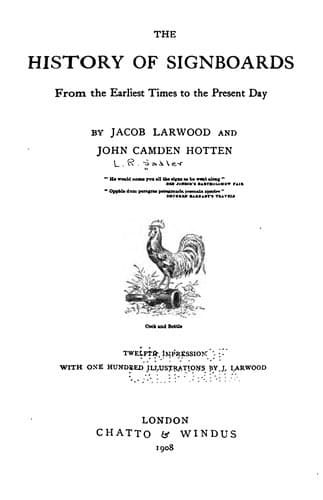
The History of Signboards, from the Earliest times to the Present DayHotten, John Camden
History
The History of Signboards, from the Earliest times to the Present Day
Hotten, John Camden
Inn signs -- England -- History; Signs and signboards -- History
“THE LATE Countess of Kent’s powder has been lately experimented upon
divers infected persons with admirable success. The virtues of it
against the Plague and all malignant distempers are sufficiently known
to all the Physicians of Christendom, and the Powder itself prepared
by the only person living that has the true Receipt, is to be had at
the third part of the ordinary price at Mr Calvert’s, at the Feathers
in the old Pall Mall near St James’s,” &c.
This, and other advertisements announcing equally efficacious panacea,
appeared daily in the London papers during the plague of 1665. De Foe,
in his little chronicle of the plague, often speaks of these quack
medicines.
Less dismal images are called up by “the Feathers at the side of
Leicester Fields,” which sign was evidently complimentary to its
neighbour Frederick, Prince of Wales, son of George II., who lived at
Leicester House, “the pouting house of princes,” when on bad terms with
his father, and died there in 1751. The back parlour of this tavern was
for some years the meeting-place of a club of artists and well-known
amateurs, amongst whom Stuart, the Athenian traveller; Scott, the marine
painter; Luke Sullivan, the miniature artist, engraver of the March to
Finchley; burly Captain Grose, author of the “Antiquities of England,”
and the greatest wit of his day; Mr Hearne, the antiquary; Nathaniel
Smith, the father of J. T. Smith; Mr John Ireland, then a watchmaker in
Maidenlane, and afterwards editor of Boydell’s edition of Dr Trusler’s
“Hogarth Moralised,” and several others. When this house was taken down
to make way for Dibdin’s theatre, called the Sans-souci, the club
adjourned to the COACH AND HORSES, in Castle Street, Leicester Fields.
But, in consequence of the members not proving customers sufficiently
expensive for that establishment, the landlord one evening venturing to
let them out with a farthing candle, they betook themselves to Gerard
Street and thence to the BLUE POSTS in Dean Street, where the club
dwindled to two or three members and at last died out.
An amusing anecdote is told about the Feathers, Grosvenor Street West. A
lodge of Oddfellows was held at this house, into the private chamber of
which George, Prince of Wales, one night intruded very abruptly with a
roystering friend. The society was, at the moment, celebrating some of
its awful mysteries, which no uninitiated eye may behold, and these were
witnessed by the profane intruders. The only way to repair the sacrilege
was to make the Prince and his companion “Oddfellows,” a title they
certainly deserved as richly as any members of the club. The initiatory
rites were quickly gone through, and the Prince was chairman for the
remainder of the evening. In 1851 the old public-house was pulled down
and a new gin palace built on its site, in the parlour of which the
chair used by the distinguished Oddfellow is still preserved, along with
a portrait of his Royal Highness in the robes of the order.
Public-domain text, read in full here on John Shaqi.
Reviews
Reviews
No reviews yet
Be the first to share your thoughts on this work.
Elsewhere in the archive
Join the Discussion
Join the discussion
Sign in to leave a comment or review.
Sign InorCreate an account