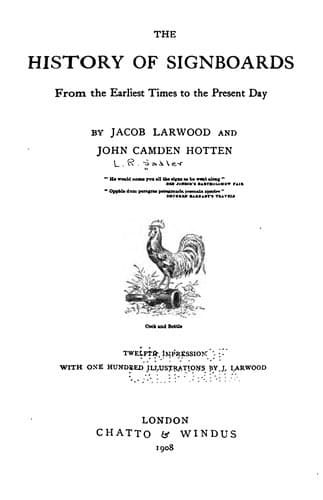
The History of Signboards, from the Earliest times to the Present DayHotten, John Camden
History
The History of Signboards, from the Earliest times to the Present Day
Hotten, John Camden
Inn signs -- England -- History; Signs and signboards -- History
One more royal, or rather princely badge remains to be mentioned,--The
FEATHERS, PRINCE OF WALES’ FEATHERS, occasionally varied to the PRINCE
OF WALES’ ARMS. Ostrich feathers were from a very early period among the
devices of our kings and princes. King Stephen, for instance, according
to Guillim, bore a plume of ostrich feathers with the motto:--VI NULLA
INVERTITUR ORDO, _No force alters their fashion_, meaning that no wind
can ruffle a feather into lasting disorder. Not only the Black Prince,
but also Edward III., himself and his sons, bore ostrich feathers as
their cognizances, each with some distinction in colour or metal. The
badge originally took the form of a single feather. John Ardern,
physician to the Black Prince, who is the first to mention the
derivation of the feathers from the King of Bohemia, says:--
“Et nota quod _talem pennam albam_ portabat Edwardus primogenitus
filius Edwardi regis super crestam suam, et _illam pennam_ conquisivit
de rege Boemiæ, quem interfecit apud Cresse in Francia, et sic
assumpsit sibi _illam pennam_ quæ dicitur _ostrich feather_, quam
prius dictus rex nobilissimus portabat super crestam.”[152]
The feather, also, is drawn in the margin of the MS. as single, and in
that shape, too, it is represented on the Black Prince’s tomb. This
feather, however, appears only to have been an ornament on the helmet of
King John of Bohemia. A contemporary Flemish poem, quoted by Baron van
Reiffenberg, thus describes his heraldic crest:--
“Twee ghiervogelen daer aen geleyt
Die al vol bespringelt zyn
Met Linden bladeren gult fyn,
Deze is, as ik merken kan
Van Bohemen Koninck Jan.”[153]
And in that shape it also occurs on the King’s seal. More difficulties
are offered by the motto: HOU MOET ICH DIEN, for so it is in full,--the
Black Prince himself wrote it after this fashion in a letter dated April
25, 1370. The last two words in German mean “I serve,” but no
explanation is given of the remainder, “Hou moet.” Since no mottos in
two languages occur, we must look for a language which can account for
both parts of the motto; and thus in Flemish we find these words to
mean, “Keep courage, I serve,” or, in less concise language, “Keep
courage, I serve with you, I am your companion in arms;” and though no
parentage has as yet been found for this motto, it may not improbably
have been derived from the Black Prince’s maternal family, since his
mother, Queen Philippa of Hainault, was a Flemish princess.
Amongst the many shops which took the feathers for their sign we find
the following noted in an advertisement:--
Public-domain text, read in full here on John Shaqi.
Reviews
Reviews
No reviews yet
Be the first to share your thoughts on this work.
Elsewhere in the archive
Join the Discussion
Join the discussion
Sign in to leave a comment or review.
Sign InorCreate an account