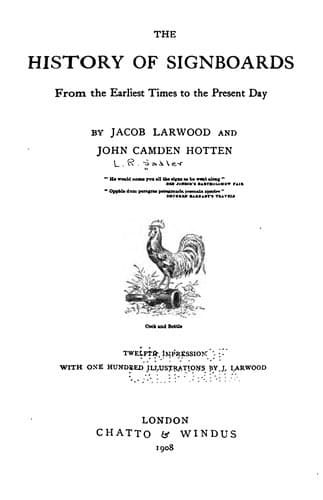
The History of Signboards, from the Earliest times to the Present DayHotten, John Camden
History
The History of Signboards, from the Earliest times to the Present Day
Hotten, John Camden
Inn signs -- England -- History; Signs and signboards -- History
Hogarth has represented one of the rooms of the house in his “Rake’s
Progress.” In 1766 this tavern was swallowed up in the enlargements of
Drury Lane by Garrick, but the sign was preserved and hung up against
the front wall, between the first and second floor windows.[154]
Two other Roses, not without thorns, are mentioned by Tom Brown:--
“Between two Roses down I fell,
As ’twixt two stools a platter;
One held me up exceeding well,
Th’ other did no such matter.
The Rose by Temple Bar gave wine
Exchanged for _chalk_, and filled me,
But being for the _ready coin_,
The Rose in Wood Street killed me.”
The “Rose by Temple Bar” stood at the corner of Thanet Place. Strype
says it was “a well customed house, with good conveniences of rooms and
a good garden.” Walpole mentions a painted room in this tavern in his
letters of January 26 and March 1, 1776. The Rose in Wood Street was a
spunging-house: “I have been too lately under their [the Bayliffs’]
clutches, to desire any more dealings with them, and I cannot come
within a furlong of the _Rose spunging-house_ without five or six yellow
boys in my pocket to cast out those devils there, who would otherwise
infallibly take possession of me.”--_Tom Brown’s Works_, iii. p. 24.
Innumerable other Rose inns and taverns might be mentioned, but we will
conclude with noting the Rose Inn at Wokingham, once famous as the
resort of Pope and Gay. There was a room here called “Pope’s room,” and
a chair was shown in which the great little man had sat. It is also
celebrated in the well-known song of Molly Mog, attributed to Gay, and
printed in Swift’s “Miscellanies.” “This cruel fair, who was daughter of
John Mog, the landlord of that inn, died a spinster at the age of 67. Mr
Standen of Arborfield, who died in 1730, is said to have been the
enamoured swain to whom the song alludes. The current tradition of the
place is, that Gay and his poetic friends having met upon some occasion
to dine at the Rose, and being detained within doors by the weather, it
was proposed that they should write a song, and that each person present
should contribute a verse: the subject proposed was the Fair Maid of the
Inn. It is said that by mistake they wrote in praise of Molly, but that
in fact it was intended to apply to her sister Sally, who was the
greater beauty. A portrait of Gay still remains at the inn.”[155] The
house at present is changed into a mercer’s shop.
Sometimes the Rose is combined with other objects, as the ROSE AND BALL,
which originated in the Rose as the sign of a mercer, and the Ball as
the emblem or device which silk dealers formerly hung at their doors
like the Berlin wool shops of the present day. (_See_ under _Ball_.) The
ROSE AND KEY was a sign in Cheapside in 1682.[156] This combination
looks like a hieroglyphic rendering of the phrase, “under the rose,” but
the key is of very common occurrence in other signs, as will be seen
presently.
Public-domain text, read in full here on John Shaqi.
Reviews
Reviews
No reviews yet
Be the first to share your thoughts on this work.
Elsewhere in the archive
Join the Discussion
Join the discussion
Sign in to leave a comment or review.
Sign InorCreate an account