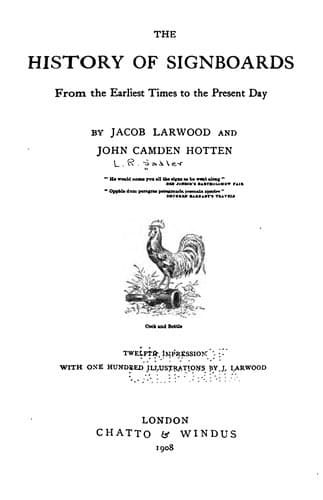
The History of Signboards, from the Earliest times to the Present DayHotten, John Camden
History
The History of Signboards, from the Earliest times to the Present Day
Hotten, John Camden
Inn signs -- England -- History; Signs and signboards -- History
The Scotch THISTLE AND CROWN is another not uncommon national badge,
adopted mostly by publicans of North British origin. The CROWN AND HARP
is less frequent; there is one at Bishop’s Cleeve, Cheltenham. Of the
CROWN AND LEEK we know only one example, viz., in Dean Street, Mile
End; but since both the rose and thistle are crowned, why not the leek
also? It is “a wholesome food,” according to Fluellen, and would no
doubt look just as well under a crown as in a Welshman’s cap. The
SHAMROCK also is of common occurrence, but we have never seen it
combined with the Crown.
Among heraldic signs referring to towns are the BIBLE AND THREE CROWNS,
the coat of arms of Oxford, which was not uncommon with the booksellers
in former times. To one of them, probably, belonged the carved stone
specimen walled up in a house at the corner of Little Distaff Lane and
St Paul’s Churchyard. Such a sign is also mentioned in a rather curious
advertisement in the _Postboy_, September 27, 1711:--
“THIS IS to give notice That ten Shillings over and above the Market
price will be given for the Ticket in the £1,500,000 Lottery, No. 132,
by Nath. Cliff at the Bible and Three Crowns in Cheapside.”
The _Spectator_ in his 191st number took occasion from this
advertisement to write a very amusing paper on the various lottery
superstitions with regard to numbers.
There is also an OXFORD ARMS Inn in Warwick Lane, Newgate Street; a
fine, old, galleried inn, with exterior staircases leading to the
bed-rooms. This was already a carriers’ inn before the fire, as appears
from the following advertisement:--
“THESE ARE to give notice that Edward Barlet, Oxford Carrier, hath
removed his Inn in London from the Swan at Holborn Bridge, to the
Oxford Arms in Warwick Lane, where he did inne before the fire. His
coaches and waggons going forth on their usual days, Mondays,
Wednesdays, and Fridays. He hath also a hearse with all things
convenient to carry a corps to any part of England.”[157]
The BUCK IN THE PARK, Curzon Street, Derby, is the vernacular rendering
of the arms of that town, which are--a hart cumbant on a mount, in a
park paled, all proper. The THREE LEGS was the sign of a bookseller
named Thomas Cockerill, over against Grocer’s Hall, in the Poultry,
about 1700. Sometimes his house is designated on his publications as the
THREE LEGS AND BIBLE. These three legs were the Manx arms. It is still a
not uncommon alehouse sign. There is one, for instance, in Call Lane,
Leeds, which is known to the lower classes under the jocular
denomination of “_the kettle with three spouts_.”
Public-domain text, read in full here on John Shaqi.
Reviews
Reviews
No reviews yet
Be the first to share your thoughts on this work.
Elsewhere in the archive
Join the Discussion
Join the discussion
Sign in to leave a comment or review.
Sign InorCreate an account