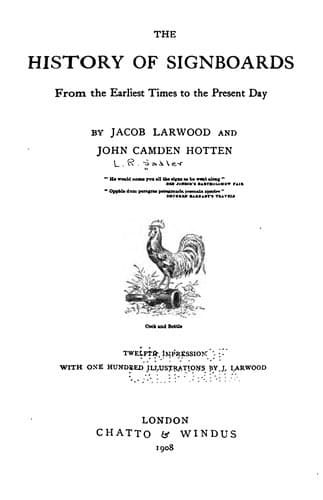
The History of Signboards, from the Earliest times to the Present DayHotten, John Camden
History
The History of Signboards, from the Earliest times to the Present Day
Hotten, John Camden
Inn signs -- England -- History; Signs and signboards -- History
This, again, led to the custom of prefixing to inns the arms of men of
note who had sojourned in the house, as may be seen in Machyn’s
Diary:--“The xxv day of January [1560] toke ys gorney into Franse,
inbassadur to the Frenche kyng, the yerle of Bedford and he had iij
dozen of _logyng skochyons_,” (lodging escutcheons). Thus, on the road
from London to Westchester the coats of arms of several of the
lord-lieutenants of Ireland might formerly have been observed, either as
signs to inns or else framed and hung in the best rooms. That this was a
general custom with ambassadors appears from Sir Dudley Digge’s
“Compleat Ambassador,” 1654; who, alluding in his preface to the reserve
of English ambassadors, observes:--“We have hardly any notion of them
but their arms, which are hung up in inns where they passed.” Montaigne
also mentions this practice as usual in France:--“A Plombières il me
commanda à la faveur de son hostesse, _selon l’humeur de la nation_, de
laisser un escusson de ses armes en bois, qu’un peintre dudict lieu fist
pour un escu; et le fist l’hostesse curieusement _attacher à la muraille
pas dehors_.”[165]
But the feudal relations between the higher and lower classes
contributed above all to the adoption of this description of signs. A
vassal, for instance, would set up the arms or crest of his feudal
lord; a retired soldier the arms of the knight under whose banneret he
had gathered both glory and plunder; an old servant the badge he had
worn when he stood at the trencher, or followed his master in the chase;
and, doubtless, many publicans adopted for their sign the badge of the
neighbouring wealthy noble, in order to court the custom of his
household and servants.
Bagford, in his MS. notes about the art of printing,[166] has jotted
down a list of signs originated from badges, which we will transcribe in
all the unrestrained freedom of Bagford’s spelling, in which, as well as
in bad writing, he surpassed all his contemporaries, (_see_ note, p.
102:)--
“Then for ye original of signes used to be set over ye douers of
tradesmen, as Inkepers, Taverns, etc., thay hauing been domestic
saruants to some nobleman, thay leauing ther Masters saruis toke to
themselves for ther signes ye crest, bag,[167] or ye arms of ther Ld.,
and thes was a destincsion or Mark of one Mannes house from anouther,
and [not] only by printers but all outher trades: and these seruants
of kinges, queenes, or noblemen, being ther domestick saruants, and
wor ther Leuirs[168] and Bages, as may be sene these day ye maner of
the Leuirs and Bagges by ye wattermen:--
Public-domain text, read in full here on John Shaqi.
Reviews
Reviews
No reviews yet
Be the first to share your thoughts on this work.
Elsewhere in the archive
Join the Discussion
Join the discussion
Sign in to leave a comment or review.
Sign InorCreate an account