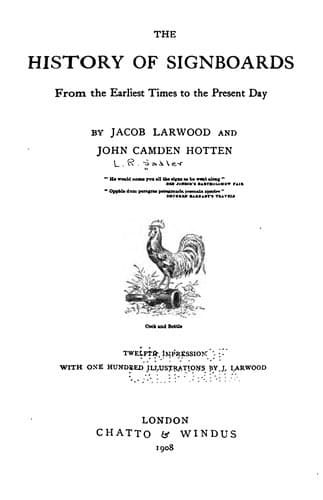
The History of Signboards, from the Earliest times to the Present DayHotten, John Camden
History
The History of Signboards, from the Earliest times to the Present Day
Hotten, John Camden
Inn signs -- England -- History; Signs and signboards -- History
This sign was frequently adopted by innkeepers and other tenants of
religious houses, even after the Reformation; for the Cross Keys figure
in the arms of the Bishops of York, Cashel, Exeter, Gloster, and
Peterborough. At the Cross Keys in Gracechurch Street, where Tarlton,
the comic actor, went to see fashions, Banks used to perform with his
wonderful bay horse before a crowded house. This was in the days of
Queen Elizabeth, when the inn consisted of a large court with galleries
all round, which, like many other old London inns, was often used as an
extempore theatre by our ancestors. It is named in 1681[161] amongst the
carriers’ inns, and is in existence at the present day. The Cross Keys
was the sign of a tavern near Thavies Inn in 1712:--
“May the Cross Keys near Thavies Inn succeed,
And famous grow for choicest white and red;
That all may know, who view that costly sign,
Those golden keys command celestial wine.”
_The Quack Vintners. A Satire._ 1712.
Besides, it is famous as the sign of Bernard Lintot, 1736, the publisher
of Gay’s works, and many other popular books of that day. His shop was
situated between the Temple Gates, in Fleet Street. The CROSS KEYS AND
BIBLE was the sign of J. Bell, in Cornhill, 1711.
Most numerous among heraldic signs were the crests, arms, and
badges[162] of private families. The causes which dictated the
choice of such subjects were various. One of the earliest was this:--
“In towns the hospitality of the burghers was not always given gratis,
for it was a common custom even amongst the richer merchants to make a
profit by receiving guests. These letters of lodgings were
distinguished from the innkeepers or _hostelers_ by the name of
_herbergeors_, or people who gave harbour to strangers, and in large
towns they were submitted to municipal regulations. The great barons
and knights were in the custom of taking up their lodgings with those
herbergeors rather than going to the public hostel, and thus a sort of
relationship was formed between particular nobles or kings and
particular burghers, on the strength of which the latter _adopted the
arms of their habitual lodgers as their sign_.”[164]
Public-domain text, read in full here on John Shaqi.
Reviews
Reviews
No reviews yet
Be the first to share your thoughts on this work.
Elsewhere in the archive
Join the Discussion
Join the discussion
Sign in to leave a comment or review.
Sign InorCreate an account