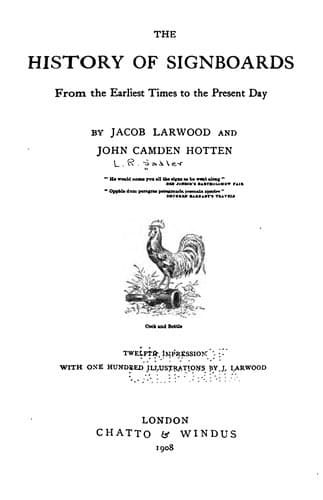
The History of Signboards, from the Earliest times to the Present DayHotten, John Camden
History
The History of Signboards, from the Earliest times to the Present Day
Hotten, John Camden
Inn signs -- England -- History; Signs and signboards -- History
WHETE-SHEAFE, ye Earle of Exeter, ye Lord Burley, etc.
APE, _clogged_, ye House of Suffolcke.
BUTTERFLIE, _white_, ye Lord Audle.
CAMEL, ye Earle of Worster.
YE 3 FLUER DE LUSES, ye King of France.
FOOLES HEAD, ye Earle of Bath.
GRAYHOND, ye Ld. Clinton; white, ye fameley of ye Druries.
GRAYHONDES HEAD, ye Lord Rich.
HART, _White_, Kg. Richard ye 2 and Sir Walter Rowley.[175]
HORSE, _White_, ye Earle of Arondele.
HORNES, _2 of seluer_,[176] ye Ld. Cheney.
MILSALE or WINDMIL, ye Lord Willobe.
ROSE IN YE SUNBEAMS, ye Ld. Wardon of ye 8 ports.
SPEARHEAD, Pembroke.
VNICORNE, _White_, ye Ld. Windsor.”
The arms of the lord of the manor were often put up as a sign,--a custom
that has continued to our day, particularly in villages, where the inn
invariably displays the name or coat-armour of the ground-landlord,
whose steward once or twice in the year meets at the house the tenantry
with their rents and land dues. Should the estate pass into other hands,
the inn will most probably change its sign for the arms of the new
purchaser. The house, as it were, wears the livery of the master,
although, so far as heralds’ visitations are concerned, this may be as
unauthorised as many other advertisements of noble descent, or gentle
extraction, in use amongst the wealthy and the proud.
In ancient times, as we have seen, the great landowners performed the
duties of innkeepers, and their arms were hung or carved at the
entrances to the castles, as indications to wayfarers who was the lord
and master in those parts. The keep in those days was rarely without a
stranger or two, either travelling mechanics or persons acquainted with
mysteries,--as trades and professions were termed in those days,--or
vagabond soldiers on the tramp for a new master to fight under. Greater
people were admitted further in the castle, but the common sort fared
with the servants. According to the good-nature of the all-powerful lord
was the fare good or bad, plentiful or meagre. It was, however,
generally the custom in those early times to be profuse in all matters
of food-bounty. The house-steward made charges for any extras, and the
comfort obtainable generally depended on the liberality or greediness of
these personages. As population increased, travellers became too
numerous for the accommodation provided. Stewards also became old, and
detached premises were given or built for them to carry on the business
away from the castle or great house. The arms of the landlord were of
course put up outside the house, and on occasion of predatory excursions
or family fights, when other nobles joined their troops with those of
the landlord, the soldiers were usually quartered at the inn outside
the castle. As in all cases of public resort, people soon began to have
fancies, and this Red Lion and that Greyhound became famous through the
country for the good entertainment to be had there. In this manner Red
Public-domain text, read in full here on John Shaqi.
Reviews
Reviews
No reviews yet
Be the first to share your thoughts on this work.
Elsewhere in the archive
Join the Discussion
Join the discussion
Sign in to leave a comment or review.
Sign InorCreate an account