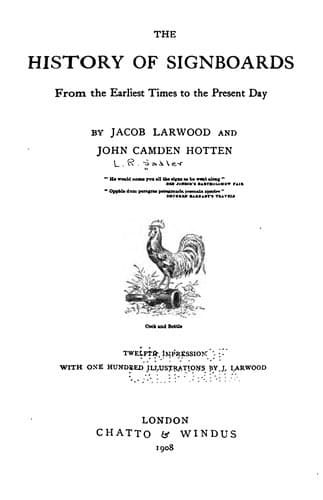
The History of Signboards, from the Earliest times to the Present DayHotten, John Camden
History
The History of Signboards, from the Earliest times to the Present Day
Hotten, John Camden
Inn signs -- England -- History; Signs and signboards -- History
Lions and Greyhounds found their way on to the signboards of the inns
within the walled cities. The men of the castle, too, used those houses
bearing their master’s arms when they visited the town. It will be
readily seen that the name of a favourite tavern would quickly suggest
its adoption elsewhere, and in this way the heraldic emblem of a family
might be carried where that family was neither known nor feared.
Latterly, however, as all traces of the origin and meaning of these
“Arms” have died out, or become removed from the understanding of
publicans and brewers, the uses to which the word has been applied are
most absurd and ridiculous. Not only do we meet constantly with arms of
families nobody ever heard of, nor cares to hear about, but all sorts of
impossible “Arms” are invented, as JUNCTION ARMS, GRIFFIN’S ARMS,
CHAFFCUTTER’S ARMS, UNION ARMS,[177] GENERAL’S ARMS, ANTIGALLICAN ARMS,
FARMERS’ ARMS, DROVERS’ ARMS, &c., (_see_ Introduction.)
In tavern heraldry the ADAM’S ARMS ought certainly to have the
precedence: the publicans generally represent these by a pewter pot and
a couple of crossed tobacco pipes, differing in this from Sylvanus
Morgan, a writer on heraldry, who says that Adam’s arms were “Paly
Tranchy divided every way and tinctured of every colour,”[178] The
shield was in the shape of a spade, which was used
“When Adam delved and Eve span,”
whilst from the spindle of our first mother the female lozenge-shaped
shield is said to be derived.
One of the most popular heraldic signs is the BEAR AND RAGGED STAFF, the
crest of the Warwick family:--
“_War._ Now, by my father’s badge, old Nevil’s crest,
The rampant bear chain’d to the ragged staff,
This day I’ll wear aloft my burgonet.”
_Henry VI._, Part II. a. v. s. 1.
Arthgal, the first Earl of Warwick, in the time of King Arthur, was
called by the ancient British the Bear, for having strangled such an
animal in his arms; and Morvidius, another ancestor of this house, slew
a giant with a club made out of a young tree; hence the family bore the
Bear and Ragged Staff.
“When Robert Dudley was governor in the Low Countries with the high
title of his Excellencie, disusing his own coat of the Green Lion[179]
with two tails, he signed all instruments with the crest of the Bear and
Ragged Staff. He was then suspected by many of his jealous adversaries
to hatch an ambitious design to make himself absolute commander (as the
lion is king of beasts) over the Low Countries. Whereupon some--foes to
his faction and friends to the Dutch freedom--wrote under his crest set
up in public places:--
‘Ursa caret cauda, non queat esse leo.’
‘The Bear he never can prevail
To lion it for lack of tail.’
Which gave rise to a Warwickshire proverb, in use at this day,--_The
Bear wants a tail and cannot be a Lion._”[180]
Public-domain text, read in full here on John Shaqi.
Reviews
Reviews
No reviews yet
Be the first to share your thoughts on this work.
Elsewhere in the archive
Join the Discussion
Join the discussion
Sign in to leave a comment or review.
Sign InorCreate an account