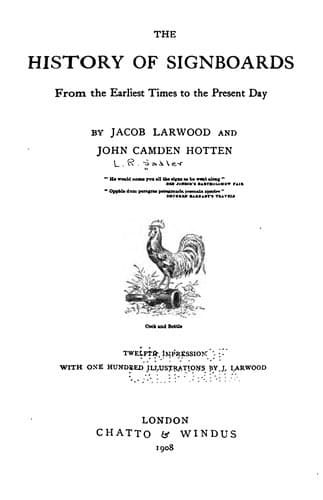
The History of Signboards, from the Earliest times to the Present DayHotten, John Camden
History
The History of Signboards, from the Earliest times to the Present Day
Hotten, John Camden
Inn signs -- England -- History; Signs and signboards -- History
At Nortwich and Altringham, Chester, there is a sign called the BLEEDING
WOLF, which has not been found anywhere else. Its origin is difficult to
explain, and the only explanation that can be immediately offered for it
is the crest of Hugh Lupus and Richard, first and second Earls of
Chester, which was a wolf’s head erased; the neck of the animal being
_erased_ may, by primitive sign-painters, have been represented less
conventionally than is done now, and probably exhibited some of the torn
parts, whence the name of the _Bleeding_ Wolf. As for the use of the
term “wolf,” instead of “wolf’s head,” we have a parallel instance in
one of the gates of Chester, which, from this crest, was called
Wolfsgate instead of Wolfshead Gate. There is another equally puzzling
sign, peculiar to this county and to Lancashire--namely, the BEAR’S PAW.
Of this sign, it must be confessed that no explanation can be offered;
it certainly looks heraldic, and lions jambs erased are the crest of
many families.
Easy enough to explain is the sign of PARTA TUERI, (Cellarhead,
Staffordshire,) which is the motto of the Lilford family: this is the
only instance as yet met with of a family motto standing for a sign;
though in Essex a public-house sign, representing a sort of Bacchic coat
of arms, with the motto, IN VINO VERITAS, may be seen. The OAKLEY ARMS,
at Maidenhead, near Bray, deserves passing mention, on account of some
amusing verses _connected with the_ place. As it is frequently the
custom with publicans to choose for their sign the name or picture of
some real or imaginary hero connected with the locality in which their
house stands, the following verses were written on the Oakley Arms, near
Bray:--
“Friend Isaac, ’tis strange you that live so near Bray
Should not set up the sign of the Vicar.[191]
Though it may be an odd one, you cannot but say
It must needs be a sign of good liquor.”
Answer:
“Indeed, master Poet, your reason’s but poor,
For the Vicar would think it a sin
To stay, like a booby, and lounge at the door,--
’Twere a sign ’twas bad liquor within.”
The WENTWORTH ARMS, Kirby Mallory, Leicestershire, may also be mentioned
on account of its peculiar inscription, which has a strange moral air
about it, as if a pious Boniface drew beer and uncorked wine, and wished
to compromise matters on high moral grounds, and limit with puritanical
rigidity the government regulation above his door, “to be Drunk on the
Premises”:--
“May he who has little to spend, spend nothing in drink;
May he who has more than enough, keep it for better uses.
May he who goes in to rest never remain to riot,
And he who fears God elsewhere never forget him here.”
Public-domain text, read in full here on John Shaqi.
Reviews
Reviews
No reviews yet
Be the first to share your thoughts on this work.
Elsewhere in the archive
Join the Discussion
Join the discussion
Sign in to leave a comment or review.
Sign InorCreate an account