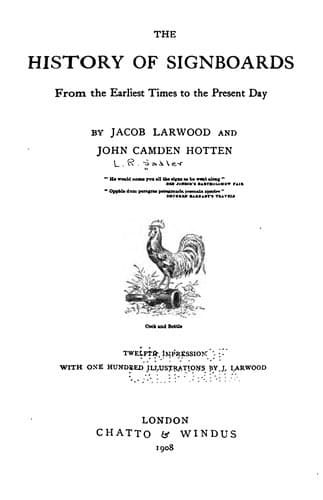
The History of Signboards, from the Earliest times to the Present DayHotten, John Camden
History
The History of Signboards, from the Earliest times to the Present Day
Hotten, John Camden
Inn signs -- England -- History; Signs and signboards -- History
Other heraldic animals, different from those just mentioned, belong to
so many various families, that it is utterly impossible to say in honour
of whom they were first set up: such, for instance, is the GRIFFIN, the
armorial bearing of the Spencers, and innumerable other houses. Besides
being an heraldic emblem, the griffin was an animal in whose existence
the early naturalists firmly believed. Its supposed eggs and claws were
carefully preserved, and are frequently mentioned in ancient inventories
and lists of curiosities. “They shewed me,” [in a church at Ratisbonne,]
says Lady Mary Wortley Montagu, in one of her letters, “a prodigious
claw, set in gold, which they called the claw of a griffin; and I could
not forbear asking the reverend priest that shewed it, whether the
griffin was a saint? The question almost put him beside his gravity, but
he answered, ‘They only kept it as a curiosity.’” The supposed eggs (no
doubt ostrich eggs) were frequently made into drinking cups. The
Tradescants had one in their collection, kept in countenance by an egg
of a dragon, two feathers of the tail of a phœnix, and the claw of a
ruck, “a bird able to trusse an elephant.” Sir John Mandeville gives the
natural history of the griffin, in his “Right Merveylous Travels,” chap.
xxvi. From him we learn that the body of this dreadful beast was larger
and stronger than “8 lions or 100 eagles,” so that he could with ease
fly off to his nest with a great horse, or a couple of oxen yoked
together, “for,” says he, “he has his talouns so large and so longe, and
so gret upon his feet as thowghe thei weren hornes of grete oxen, or of
bugles or of kijgn.”
In the original edition of the _Spectator_, No. xxxiii.,[192] the
griffin is mentioned as the sign of a house in Sheer Lane, Temple Bar.
The advertisement begins oddly enough:--“Lost, yesterday, _by a Lady in
a velvet furbelow scarf_, a watch,” &c. The GOLDEN GRIFFIN was a famous
tavern in Holborn, of which there are trades tokens extant of the
seventeenth century. Tom Brown talks of a “fat squab porter at the
Griffin Tavern, in Fulwood’s rents,” which is the same house, as appears
from Strype:--“At the upper end of this court is a passage into the
Castle Tavern, a house of considerable trade, as is the Golden Griffin
Tavern, on the west side, which has a passage into Fulwood’s rents,”
(Book iii., p. 253.)
Public-domain text, read in full here on John Shaqi.
Reviews
Reviews
No reviews yet
Be the first to share your thoughts on this work.
Elsewhere in the archive
Join the Discussion
Join the discussion
Sign in to leave a comment or review.
Sign InorCreate an account