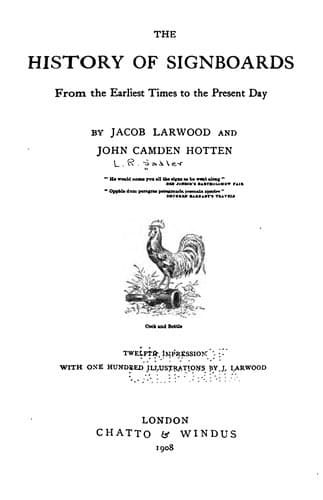
The History of Signboards, from the Earliest times to the Present DayHotten, John Camden
History
The History of Signboards, from the Earliest times to the Present Day
Hotten, John Camden
Inn signs -- England -- History; Signs and signboards -- History
The HAMMER AND CROWN appears from a trades token to have been the sign
of a shop in Gutter Lane, in the seventeenth century. It was a charge
from the Blacksmiths’ arms: sable, a chevron between three hammers
crowned _or_. The LION IN THE WOOD was a tavern of some note a hundred
years ago in Salisbury Court, Fleet Street. It seems originally to have
been the Woodmongers’ arms, whose crest is a lion issuing from a wood.
At the present day it is the sign of a public-house in the same
locality, namely, in Wilderness Lane, Dorset Street, Fleet Street.
To these Corporation arms we may add two belonging to companies. During
the South Sea mania the SOUTH SEA ARMS was a favourite sign; in 1718,
the very year that Queen Anne had established the company and granted
them arms, they appeared as the sign of a tavern near Austin Friars:
they are a curious heraldic compound. “Azure, a globe representing the
Straights of Magellan and Cape Horn, all proper. On a canton the arms of
the United Kingdoms of Great Britain, and in sinister chief two herrings
salterwise _arg._, crowned _or_.”
The SOL’S ARMS, Sol’s Row, Hampstead Road, immortalised by Dickens in
“Bleak House,” derives its name from the Sol’s Society, who were a kind
of freemasons. They used to hold their meetings at the Queen of
Bohemia’s Head, Drury Lane, but on the pulling down of that house the
society was dissolved.
[121] History of Musick.
[122] Harl. MSS. 5910, vol. i. fol. 193. The reader will be amused with
the spelling of this extract from the original manuscript, written when
Addison was penning “Spectators,” and many classic English compositions
were issuing from the press. Old Mr Bagford was a genuine antiquary, and
despised new hats, new coats, and anything approaching the new style of
spelling, with other changes then being introduced.
[123] Misson’s Memoirs and Observations in his Travels over England.
London, 1719.
[124] England is the country, _par excellence_, for gigantic dinners,
amongst which agricultural repasts stand foremost; even that nuptial
dinner of Camacho, at which honest Sancho Panza did such execution,
would scarcely rank as a lunch beside the Homeric dinners of our
farmers. In our times we have seen Soyer roast a whole ox for the
Agricultural Society at Exeter; the details of this culinary feat are
somewhat interesting: it was called a “baron with saddle back of beef _à
la magna charta_, weighing 535 lbs., the joints being the whole length
of the ox, rumps, rounds, loins, ribs, and shoulders to the neck. It was
roasted in the open air within a temporary enclosure of brick work, the
monster joint steaming and frizzling away over 216 jets of gas from
pipes of an inch diameter, the whole being covered in with sheet iron;
when in 5 hours the beef was dressed for 5 shillings.”--_Hints for the
Table._
[125] Various examples of it occur in the Banks Bills.
[126] Original Weekly Journal, March 29 to April 3, 1718.
[127] Banks Bills.
Public-domain text, read in full here on John Shaqi.
Reviews
Reviews
No reviews yet
Be the first to share your thoughts on this work.
Elsewhere in the archive
Join the Discussion
Join the discussion
Sign in to leave a comment or review.
Sign InorCreate an account