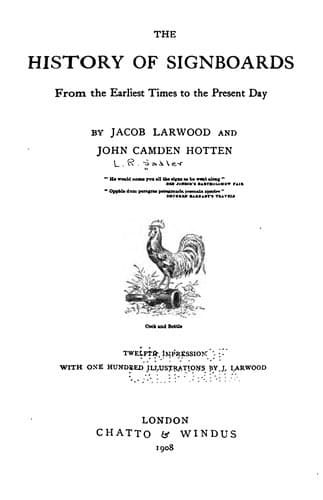
The History of Signboards, from the Earliest times to the Present DayHotten, John Camden
History
The History of Signboards, from the Earliest times to the Present Day
Hotten, John Camden
Inn signs -- England -- History; Signs and signboards -- History
“In our street,” says Pepys, “at the Three Tuns Tavern, I find a great
hubbub; and what was it but two brothers had fallen out, and one
killed the other. And who should they be but the two Fieldings. One
whereof, Bazill, was page to my Lady Sandwich, and he hath killed the
other, himself being very drunk, and so is sent to Newgate.”[194]
There seems to have been a kind of fatality attached to this sign, for
the _London Gazette_ for September 15-18, 1679, relates a murder
committed at the Three Tuns, in Chandos Street, and in this same house,
Sally Pridden, _alias_ Sally Salisbury, in a fit of jealousy stabbed the
Honourable John Finch in 1723. Sally was one of the handsomest “social
evils” of that day, and had been nicknamed Salisbury, on account of her
likeness to the countess of that name. For her attempt on the life of
Finch she was committed to Newgate, where she died the year after,
“leaving behind her the character of the most notorious woman that ever
infested the hundreds of old Drury.”[195] Her portrait has been painted
by Sir Godfrey Kneller.
Sometimes the sign of the ONE TUN may also be seen. It occurs in the
following newspaper item:--
“Last Thursday four highwaymen drinking at the One Tun Tavern near
Hungerford Market in the Strand, and falling out about dividing their
booty, the Drawer overheard them, sent for a constable, and secured
them, and next day they were committed to Newgate.”--_Weekly Journal_,
December 6, 1718.
That these fellows meant mischief is evident from a subsequent article.
They had a complete arsenal about them, viz., two blunderbusses, one
loaded with fifteen balls, the other with seven, and five pistols loaded
with powder and shot.
The GOLDEN CUP, from the form in which it was generally represented,
seems to have been derived from the Goldsmiths’ arms, which are
quarterly azure, two leopards’ heads _or_, (whence the mint mark,) and
two golden cups covered between two buckles _or_. It was a sign much
fancied by booksellers, as: Abel Jeff’s in the Old Bailey, 1564; Edward
Allde, Without Cripplegate, from 1587 until 1600; and John Bartlet the
Elder, in St Paul’s Churchyard; whilst the THREE CUPS was a famous
carriers’ inn in Aldersgate in the seventeenth century.
The RAM AND TEAZEL, Queenshead Street, Islington, is a part of the
Clothworkers’ arms, which are sable, a chevron ermine between two
habicks in chief _arg._, and a teasel in base _or_. The crest is a ram
statant _or_ on a mount vert.
Public-domain text, read in full here on John Shaqi.
Reviews
Reviews
No reviews yet
Be the first to share your thoughts on this work.
Elsewhere in the archive
Join the Discussion
Join the discussion
Sign in to leave a comment or review.
Sign InorCreate an account