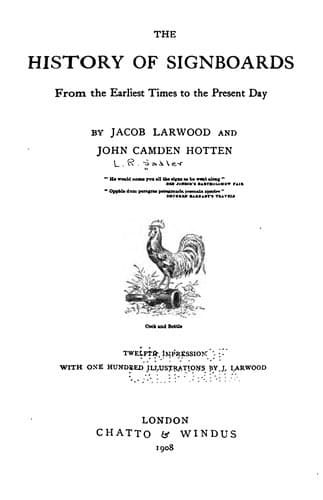
The History of Signboards, from the Earliest times to the Present DayHotten, John Camden
History
The History of Signboards, from the Earliest times to the Present Day
Hotten, John Camden
Inn signs -- England -- History; Signs and signboards -- History
[156] _London Gazette_, Sept. 18-21, 1682.
[157] _London Gazette_, March 12, 1672-3.
[158] Little London Directory for 1677, the oldest printed lists of
bankers and merchants in London, reprinted, with historical introduction
by John Camden Hotten, 1863.
[159] A very amusing French author of the time of Louis XIV., celebrated
for his witty letters.
[160] “Let England amuse herself with idle fancies, and imagine that her
kings are kings of France; but that there be Frenchmen who are ignorant
enough, or bad subjects enough, to quarter the arms of France with those
of England, that is a thing which such zealous subjects as M.
d’Argenson, and the other police magistrates, ought by no means to
permit.”
[161] Thos. Delaune’s Present State of London, 1681.
[162] These badges consisted of the master’s arms, crest, or device,
either on a small silver shield or embroidered on a piece of cloth, and
fastened on the left arm of servants. A ballad in the Roxburgh
collection thus alludes to this custom:[163]--
“The nobles of our Land
were much delighted then,
To have at their command
a Crue of lustie Men,
Which by their Coats were knowne,
of Tawnie, Red, or Blue;
With crests on their sleeves showne
when this old cap was new.”
[163]
“Time’s alteration;
or,
The old man’s rehearsall what brave days he knew
A great while agone, when his old cap was new.”
Rox. Ball., i. fol. 407.
Stow gives us a good picture of a great nobleman’s retinue in the good
old time, before the nobility took to hotel-keeping:--“The late Earl of
Oxford, father to him that now liveth, has been noted within these forty
years, to have ridden into this city and so to his house by London
Stone, with eighty gentlemen, in a livery of Reading tawny, and chains
of gold about their necks, before him, and one hundred tall yeomen in
the like livery to follow him, without chains, but all having his
cognisance of the _blue boar_ embroidered on their left shoulder.” These
badges fell into disuse in the reign of James I.
[164] Wright’s Domestic Manners and Sentiments in England during the
Middle Ages, p. 333.
[165] “At Plombières he ordered me to leave with his hostess, according
to the fashion of the country, an escutcheon of his arms in wood, which
a painter of that town made for a crown and the hostess had it carefully
hung upon the wall outside the house.”
[166] Harl. MSS., 5910, vol. ii. p. 167.
[167] Badge.
[168] Liveries.
[169] Portcullises.
[170] Leopard.
[171] Wiltshire.
[172] A transcript adds to these the names of Archbishop Parker and
Jugge.
[173] This statement is modified lower down.
[174] Rivers.
[175] Raleigh.
[176] Silver.
[177] The UNION ARMS in Panton Street, Haymarket, was the public-house
of Cribb, the pugilist champion, a fact commemorated by a poet of the
prize ring, in all probability a better “fist” at smashing than at
“wooing the Muses:”--
Public-domain text, read in full here on John Shaqi.
Reviews
Reviews
No reviews yet
Be the first to share your thoughts on this work.
Elsewhere in the archive
Join the Discussion
Join the discussion
Sign in to leave a comment or review.
Sign InorCreate an account