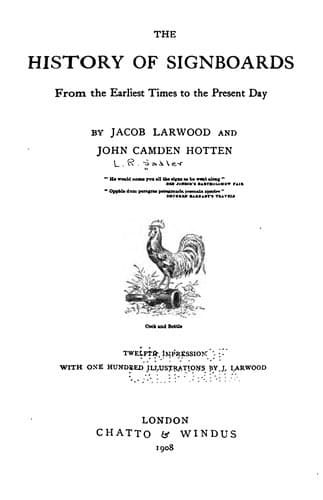
The History of Signboards, from the Earliest times to the Present DayHotten, John Camden
History
The History of Signboards, from the Earliest times to the Present Day
Hotten, John Camden
Inn signs -- England -- History; Signs and signboards -- History
“The champion I see is again on the list,
His standard--the UNION ARMS.
His customers still he will serve with his fist,
But without creating alarms.
Instead of a floorer, he tips them a glass,
Divested of joking or fib;
Then, ‘lads of the fancy,’ don’t Tom’s house pass,
But take a hand at the game of _Cribb_.”
[178] Sylvanus Morgan’s Sphere of Gentry. London, 1661.
[179] There is a sign of the GREEN LION in Short Street, Cambridge, the
only one I have ever seen.
[180] Fuller, _in voce_ Warwickshire.
[181] Delaune’s Present State of London, 1682.
[182] Printed in the Journal of Brit. Archæolog. Assoc., vol. vii. p.
71.
[183] Taylor’s Pennylesse Pilgrimage, 1630.
[184] Catherine Street, in the Strand, was a disreputable thoroughfare
in the last century. Gay alludes to it in his “Trivia:”--
“Oh, may thy virtue guard thee through the roads
Of Drury’s mazy courts and dark abodes!
The harlots’ guileful path, who nightly stand
Where Catherine Street descends into the Strand.
With empty bandbox she delights to range,
And feigns a distant errand from the ‘Change.
Nay, she will oft the Quaker’s hood profane,
And trudge demure the rounds of Drury Lane.”
Tom Brown describes, _con amore_, the wickedness of that part of the
town. Catherine Street at present is not quite so bad as formerly, but
the hundred of Drury Lane cannot by any means be called the most
virtuous part of London.
[185] Art of Living in London. Printed for William Griffin, at the
Garrickshead, in Catherine Street, in the Strand, 1768.
[186] Pennant’s Account of London, 1813, p. 618.
[187] Little London Directory for 1677, the oldest list of London
merchants.
[188] “Buy these books, which Richard Fax the printer has printed with
the wedge, with the greatest care. This little book was printed at
London, in St Paul’s Churchyard, at the Maidenhead, in the year 1509, on
the 12th of December.” The printing with the wedge was the first attempt
of the art, whence the books produced in this manner are sometimes
called _incunables_.
[189] Pleasant Conceits of old Hobson the Londoner, 1607. Hobson’s
answer proves the truth of Misson’s remark, that there were no
inscriptions on the London signs to tell what they represented,
otherwise the maid could not have been passed off as a widow.
[190] Guillim’s Display of Heraldry, folio, p. 197.
[191] The Vicar of Bray, the hero of Butler’s comic poem, appears to
have been a certain Simon Aleyn, _ob._ 1583; he was by turns, and as the
times suited, Roman Catholic and Protestant, in the times of Henry
VIII., Edward VI., Queen Mary, and Queen Elizabeth.
[192] The original edition of the _Spectator_ contained _bona fide_
advertisements like any other newspaper.
Public-domain text, read in full here on John Shaqi.
Reviews
Reviews
No reviews yet
Be the first to share your thoughts on this work.
Elsewhere in the archive
Join the Discussion
Join the discussion
Sign in to leave a comment or review.
Sign InorCreate an account