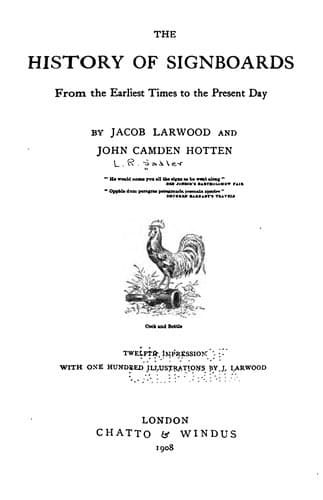
The History of Signboards, from the Earliest times to the Present DayHotten, John Camden
History
The History of Signboards, from the Earliest times to the Present Day
Hotten, John Camden
Inn signs -- England -- History; Signs and signboards -- History
THE ROEBUCK is equally common with the Stag; the GOLDEN BUCK, near St
Dunstan, was the shop of P. Overton, publisher of “The Cries of the City
of London, consisting of 74 copper-prints, each figure drawn after the
life, by the famous Mr Laron.” The BUCK AND BELL is a sign at Long
Itchington: the bell was frequently added to the signs of public-houses
in honour of the bell-ringers, who were in the habit of refreshing
themselves there. Hence we have the BULL AND BELL, Briggate, Leeds; the
RAVEN AND BELL, at Shrewsbury, Wolverhampton, and Newport; the BELL AND
TALBOT, at Bridgenorth; the DOLPHIN AND BELL on the token of John
Warner, Aldersgate, 1668; the FISH AND BELL, (evidently the same sign,)
Charles Street, Soho; the THREE SWANS AND PEAL at Walsall; the NELSON
AND PEAL, and many others.
Among the taverns with the sign of the ROEBUCK that have become famous,
the house in Cheapside may be mentioned as a notorious place during the
Whig riots in 1715.
Not only the Deer tribe themselves, but their HORNS also make a
considerable figure on the signboard. It is probably to the sign of the
Horns that allusion is made in the roll of the Pardoner, “Cocke Lorells
Bote:”--
“Here is Maryone Marchauntes at Allgate
Her Husbõde dwells at ye siggne of _ye Cokeldes Pate_.”
The HORNS was a tavern of note in Fleet Street in the reign of Queen
Elizabeth:
“The xvj day of September (1557), cam owt of Spayn to the Quens Cowrt
in post Monser Regamus, gorgysly apparelled, with divers Spaneardes,
and with grett cheynes, and their hats sett with stones and perlles,
and sopyd [supped], and by vij of the cloke were again on horsẽbake,
and so thrugh Flet Strett, and at the HORNES they dronke, and at the
GRAYHONDE, and so thrugh Chepesyde, and so over the bryge, and so rod
all nyght toward Dover.”--_Machyn’s Diary._
Sometimes the Horns are specified as the HART’S HORNS Inn, Smithfield,
near Pie Corner, one of the houses in the yard of which Joe Miller used
to play during Bartholomew Fair time, when he was associated with
Pinkethman at the head of a troop of actors. The _London Daily Post_ for
August 24, &c., 1721, contains several advertisements of his troop, and
the parts played by himself.
What most contributed to the popularity of this sign in the environs of
London was the custom alluded to by Byron:
“And many to the steep of Highgate hie,
Ask ye, Bœotian shades! the reason why,
’Tis to the worship of the solemn horn,
Grasp’d in the holy hand of mystery,
In whose dread name both men and maids are sworn,
And consecrate the oath with draught and dance till morn.”[230]
Highgate was the headquarters for this swearing on the horn. Hone gives
the oath in the following form:--
Public-domain text, read in full here on John Shaqi.
Reviews
Reviews
No reviews yet
Be the first to share your thoughts on this work.
Elsewhere in the archive
Join the Discussion
Join the discussion
Sign in to leave a comment or review.
Sign InorCreate an account