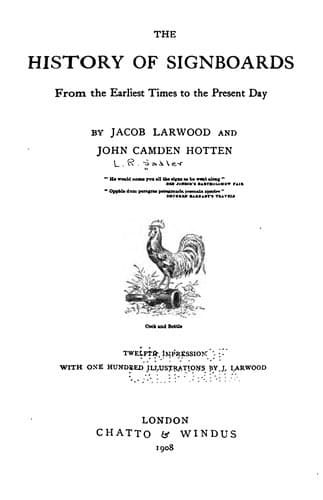
The History of Signboards, from the Earliest times to the Present DayHotten, John Camden
History
The History of Signboards, from the Earliest times to the Present Day
Hotten, John Camden
Inn signs -- England -- History; Signs and signboards -- History
The STAG may in early times have been put up as a religious type. As
such it is of constant occurrence in the catacombs and in early
Christian sculptures, in allusion to Psalm xlii., “Like as the hart
desireth the water brook, so longeth my soul after thee, O God!”[228]
The Stag is still a very common sign. A publican on the Fulham Road has
put up the sign of the Stag, and added to this on the tympanum: “Rex in
regno suo non habet parem,” the application of which is best known to
mine host himself.
The BALDFACED STAG is seen in many places: baldfaced is a term applied
to horses who have a white strip down the forehead to the nose. At
Chigwell in Essex there is a BALD HIND, and in the High Street,
Reading, a BALD FACE, both evidently derived from the last-named stag.
Various combinations also occur, as the STAG AND CASTLE, at Thornton,
near Hinckly; the STAG AND PHEASANT, rather common; both these,
doubtless, allude to the game seen in parks, or in the neighbourhood of
noblemen’s seats; the STAG AND OAK, the Cape, Warwickshire, points
towards a similar origin, but the STAG AND THORN at Traffick Street,
Derby, seems to be a union of two signs, for the THORN appears in the
same street on another public-house. There is, however, a sort of tree
called the Buck-Thorn, which possibly may have been corrupted into the
Buck and Thorn, and hence the Stag and Thorn. The RISING DEER
(Brampton-en-le-Morthen, Yorkshire) and the RISING BUCK (Sheinton,
Shropshire) have a decided deer-stalking smack about them, affording us
a glimpse of the cautious stag rising from the heather, pricking his
ears and sniffing the wind.
The RANGED DEER was the sign of the King’s gunsmith in the Minories,
1673.[229] At that period this street was full of smiths:
“The Mulcibers who in the Minories sweat
And massive bars on stubborn anvils beat,
Deform’d themselves, yet forge those stays of steel
Which arm Aurelia with a shape to kill.”--_Congreve._
This ranged deer was simply intended for the Reindeer, which animal had
then just newly come under the notice of the public; their knowledge of
it was still confused, and its name was spelled in various ways, such
as: _rain-deer_, _rained-deer_, _range-deer_, and _ranged-deer_.
Public-domain text, read in full here on John Shaqi.
Reviews
Reviews
No reviews yet
Be the first to share your thoughts on this work.
Elsewhere in the archive
Join the Discussion
Join the discussion
Sign in to leave a comment or review.
Sign InorCreate an account