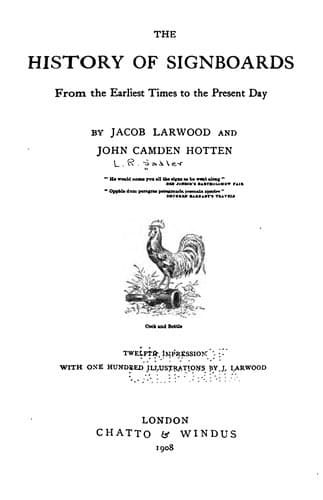
The History of Signboards, from the Earliest times to the Present DayHotten, John Camden
History
The History of Signboards, from the Earliest times to the Present Day
Hotten, John Camden
Inn signs -- England -- History; Signs and signboards -- History
These last liberties, however, are a later addition to the oath
introduced by a blacksmith, who kept the COACH AND HORSES. Nearly every
inn in Highgate used to keep a pair of horns for this custom. In Hone’s
time the principal inn, the Gatehouse, had stag-horns:--
The Mitre, stags’-horns.
The Green Dragon, do.
The Red Lion and Sun, bullocks’-horns.
The Bell, stags’-horns.
The Coach and Horses, rams’-horns.
The Castle, do.
The Red-Lion, rams’-horns.
The Coopers’ Arms, do.
The Fox and Hounds, rams’-horns.
The Flask, do.
The Rose and Crown, stags’-horns.
The Angel, rams’-horns.
The Bull, stags’-horns.
The Wrestlers, do.
The Lord Nelson, do.
The Duke of Wellington, stags’-horns.
The Crowne, do.
The Duke’s Head, do.
Hone supposes the custom to have originated in a sort of graziers’
club.[231] Highgate being the place nearest London where cattle rested
on their way from the north, certain graziers were accustomed to put up
at the Gatehouse for the night. But as they could not wholly exclude
strangers who, like themselves, were travelling on business, they
brought an ox to the door, and those who did not choose to kiss its
horns, after going through the ceremony described, were not deemed fit
members of their society. Similar customs prevailed in other places, as
at Ware, at the Griffin in Hoddesdon, &c.
On the Continent the sign of the Horns was formerly equally common,
often accompanied with some sly allusion to what Othello calls “the
forked plague.” Thus in the Rue Bourg Chavin, in Lyons, there is now a
pair of horns with the inscription “SUNT SIMILIA TUIS;” and a Dutch
shopkeeper of the seventeenth century wrote under his sign of the
Horns--
“Ik draag Hoornen dat ider ziet,
Maar menig draagt Hoornen en weet het niet.”[232]
The Fox, as might be expected, is to be seen in a great many places;
there is one at Frandley, Cheshire, with the following rhymes:--
“Behold the Fox, near Frandley stocks,
Pray catch him when you can,
For they sell here, good ale and beer,
To any honest man.”
A still more absurd inscription accompanies the sign of the Fox at
Folkesworth, near Stilton, Hunts:--
“I . HAM . A . CUNEN . FOX
YOU . SEE . THER . HIS .
NO . HARM . ATCHED .
TO . ME . IT . IS . MY . MRS
WISH . TO . PLACE . ME
HERE . TO . LET . YOU . NO .
HE . SELLS . GOOD . BEERE .”
Formerly there used to be a sign of the THREE FOXES in Clement’s Lane,
Lombard Street, carved in stone, representing three foxes sitting in a
row. But a few years ago the house came into the possession of a legal
firm, who, no doubt afraid of the jokes to which the sign might lead,
thought it advisable to do away with the carving by covering it over
with plaster.
Public-domain text, read in full here on John Shaqi.
Reviews
Reviews
No reviews yet
Be the first to share your thoughts on this work.
Elsewhere in the archive
Join the Discussion
Join the discussion
Sign in to leave a comment or review.
Sign InorCreate an account