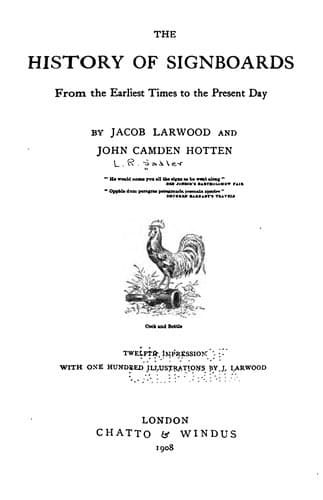
The History of Signboards, from the Earliest times to the Present DayHotten, John Camden
History
The History of Signboards, from the Earliest times to the Present Day
Hotten, John Camden
Inn signs -- England -- History; Signs and signboards -- History
Edinburgh also has its famous White Horse; in a close in the Canongate,
an inn dating from the time of Queen Mary Stuart, and which Scott has
introduced in one of his novels, may still be seen. It was well-known to
runaway couples, and hundreds have been made happy or unhappy for life
“at a moment’s notice,” in its large room, in which, as well as in the
White Hart in the Grassmarket, these _impromptu_ marriages were as
regularly performed as at Gretna Green. The WHITE HORSE CELLAR,
Piccadilly, now a tame omnibus office, was for more than a century one
of the bustling coaching inns for the West. “Some persons think the
sublimest object in nature is a ship launched on the bosom of the ocean;
but give me, for my private satisfaction, the mail coaches that pour
down Piccadilly of an evening, tear up the pavement, and devour the way
before them to the Land’s-End.”--_Hazlitt._ This place calls up pleasant
fancies of travelling by the mail, through merry roads, with blooming
hawthorn and chestnut trees, larks singing aloft, the village bells, and
the blacksmith’s hammer tinkling in the distance; but another White
Horse Inn shows the dark side of the picture--the unsafety of the roads,
for the White Horse, corner of Welbeck Street, Cavendish Square, was
long a detached public-house, where travellers customarily stopped for
refreshment, and to examine their firearms before crossing the fields to
Lisson Green.[236] The last White Horse we shall mention was in Pope’s
Head Alley, the sign of John Sudbury and George Humble, the first men
that opened a printshop in London, in the beginning of the seventeenth
century. Peacham, in his “Compleat Gentleman,” says that Goltzius’
engravings were commonly to be had in Pope’s Head Alley. There also, in
1611, the first edition of Speed’s “Great Britain” was published.
At a certain place in Warwickshire a fellow started a public-house near
four others, with signs respectively of the Bear, the Angel, the Ship,
and the Three Cups. Yet quite undaunted at his neighbours, he put up the
White Horse as his sign, and under it wrote the following spirited and
prophetic rhymes:--
“My _White Horse_ shall bite the _Bear_,
And make the _Angel_ fly;
Shall turn the _Ship_ her bottom up,
And drink the _Three Cups_ dry.”
And so it did; the lines pleased the people, the other houses soon lost
their custom, and tradition says that the fellow made a considerable
fortune.
Public-domain text, read in full here on John Shaqi.
Reviews
Reviews
No reviews yet
Be the first to share your thoughts on this work.
Elsewhere in the archive
Join the Discussion
Join the discussion
Sign in to leave a comment or review.
Sign InorCreate an account