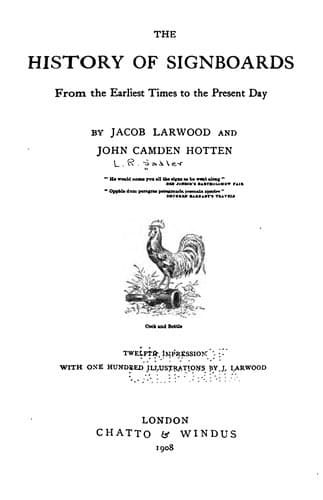
The History of Signboards, from the Earliest times to the Present DayHotten, John Camden
History
The History of Signboards, from the Earliest times to the Present Day
Hotten, John Camden
Inn signs -- England -- History; Signs and signboards -- History
The RED HORSE is now almost extinct; it occurs as the sign of a house in
Bond Street, in an advertisement about a spaniel lost by the Duke of
Grafton.[234] By the term _red_ was not meant vermilion; at that time it
was the accepted word for what we now call _roan_. The BAY HORSE is a
great favourite in Yorkshire; in 1861 there were, in the West Riding
alone, not less than seventy-seven inns, taverns, and public-houses,
with such a sign, besides innumerable ale-houses. One would expect the
YORKSHIRE GREY more indigenous to that county. The DAPPLE GREY is
apparently a tribute of gratitude of the publicans to the “Dapple Grey”
of the nursery rhyme--
“I had a little bonny nag,
His name was _Dapple Grey_,
And he would bring me to an ale-house
A mile out of the way.”
Dappled grey, too, was the fashionable colour of horses in the last
century; thus Pope’s mercenary Duchess--
“The gods, to curse Pamela with her prayers,
Gave her gilt coach and dappled Flanders mares.”
Of the WHITE HORSE innumerable instances occur, and many are
connected with names known in history. At the White Horse, near
Burleigh-on-the-Hill, the noted Villiers, Duke of Buckingham, spent the
last years of his life, and died.
“The Duke of Queensbury being present at his death, knowing the Duke
to be a dissenter, and thinking he must be a Catholic, offered to send
for a Catholic priest, to which the Duke answered, ‘No,’ said he,
‘those rascals eat God; but if you know of any set of fellows that eat
the devil, I should be obliged to you if you would send for one of
them!’”
All of a piece! So ended
“That life of pleasure, and that soul of whim.”[235]
At the White Horse in Kensington, Addison wrote several of his
_Spectators_. His favourite dinner, when he stayed at this house, was
fillet of veal and a bottle of claret. The old inn remained in its
original state till about forty years ago, when it was pulled down, and
the name changed to the HOLLAND ARMS; but the sign is still preserved in
the parlour of the new establishment.
Public-domain text, read in full here on John Shaqi.
Reviews
Reviews
No reviews yet
Be the first to share your thoughts on this work.
Elsewhere in the archive
Join the Discussion
Join the discussion
Sign in to leave a comment or review.
Sign InorCreate an account