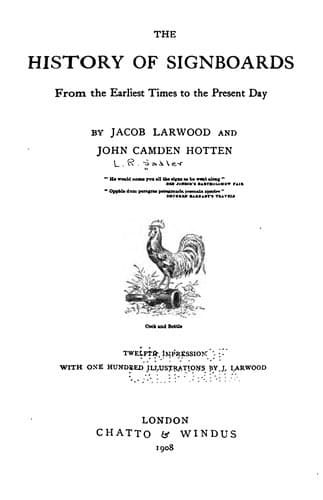
The History of Signboards, from the Earliest times to the Present DayHotten, John Camden
History
The History of Signboards, from the Earliest times to the Present Day
Hotten, John Camden
Inn signs -- England -- History; Signs and signboards -- History
The BELL AND HORSE is an old and still frequent sign; it occurs on
trades tokens; as John Harcourt at the BELL AND BLACK HORSE in Finsbury,
1668, and on various others; whilst at the present day it may be seen at
many a roadside alehouse. Bells were a favourite addition to the
trappings of horses in the middle ages. Chaucer’s abbot is described:--
“When he rode men his bridle hear,
Gingling in a whistling wind as clere,
And eke as loud as doth a chapel bell.”
In a MS. in the Cottonian Library[238] relating the journey of Margaret
of England to Scotland, there to be married to King James, we find
constant mention of these bells. The horse of Sir William Ikarguil,
companion of Sir William Conyars, sheriff of Yorkshire, is described as
“his Hors Harnays full of campanes [bells] of silver and gylt.” Whilst
the master of the horse of the Duke of Northumberland was “monted apon a
gentyll horse, and campanes of silver and gylt.” And a company of
knights is introduced, “some of their hors harnes was full of campanes,
sum of gold and sylver, and others of gold.” This led to the custom of
giving a golden bell as the reward of a race. In Chester, such a bell
was run for yearly on St George’s day; it was “dedicated to the kinge,
being double gilt with the Kynges Armes upon it,” and was carried in the
procession by a man on horseback “upon a septer in pompe, and before him
a noise of trumpets in pompe.”[239] This custom of racing for a bell led
to the adoption of the still common phrase, _bearing off the_ BELL.
Names of celebrated race horses are found on signboards as well as human
celebrities. Such are BAY CHILDERS at Dronfield, Derby; FLYING CHILDERS
at Melton Mowbray; WILD DAYRELL, Oldham; FILHO DA PUTA, Nottingham; and
FILHO tavern, Manchester. BLINK BONNY is common in Northumberland;
FLYING DUTCHMAN occurs in various places; and the ARABIAN HORSE at
Aberford, in Yorkshire, may perhaps represent the great Arabian
Godolphin, the sire of all our famous racers.
Public-domain text, read in full here on John Shaqi.
Reviews
Reviews
No reviews yet
Be the first to share your thoughts on this work.
Elsewhere in the archive
Join the Discussion
Join the discussion
Sign in to leave a comment or review.
Sign InorCreate an account