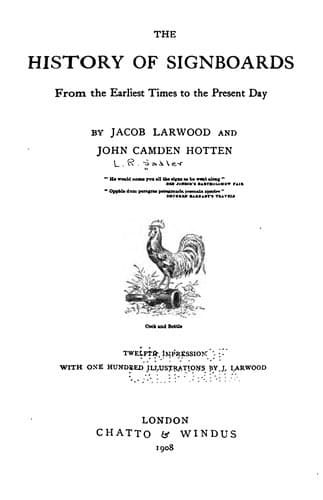
The History of Signboards, from the Earliest times to the Present DayHotten, John Camden
History
The History of Signboards, from the Earliest times to the Present Day
Hotten, John Camden
Inn signs -- England -- History; Signs and signboards -- History
The HORSE AND TIGER, at Rotherham, is said to refer to the accident in a
travelling menagerie which took place many years ago, when the tiger
broke loose and sprang upon the leaders of a passing mail coach,
although visitors from London generally suppose the “tiger” to mean the
spruce groom, or horse attendant, coming from the country to London in
such numbers. Even that poor hack, the MANAGE HORSE, is not forgotten,
as he may be seen going through his paces before a public-house in
Cottles Lane, Bath. In one of the turnings in Cannon Street, City, there
is an old sign of the HORSE AND DORSITER, which is simply an old
rendering of the more common PACK HORSE, formerly the usual sign of a
posting inn. No doubt the FRIGHTED HORSE, which occurs in many places,
belongs to this class of horses,--the expression “fright” being a
corruption of _freight_. Some publicans who, with their trade combine
the calling of farrier, set up the sign of the HORSE AND FARRIER,--in
Ireland rendered as the BLEEDING HORSE. A Dutch farrier in the village
of Schagen, in the seventeenth century, put up the sign of the WHITE
HORSE, and wrote under it the following very philosophical verse:--
“In ’t witte Paard worden de paarden haar voeten met yzer beslagen
Dat men de menschen dat mee kon doen zy hoefden dan geen schoenen te
dragen.”[240]
The HORSE AND STAG, (Finningley, Nottinghamshire,) and the HORSE AND
GATE, are both hunting signs; yet the last may have been suggested by
the Bull and Gate. The HORSE AND TRUMPET is a very common sign,
illustrating the war horse; the HORSE AND CHAISE (or shaze, as it is
spelled) in the Broad _Centry_, (sanctuary,) Westminster, is named in an
advertisement in the _Postboy_, Jan. 23-25, 1711; whilst the CHAISE AND
PAIR is still to be seen at Northill, Colchester.
Public-domain text, read in full here on John Shaqi.
Reviews
Reviews
No reviews yet
Be the first to share your thoughts on this work.
Elsewhere in the archive
Join the Discussion
Join the discussion
Sign in to leave a comment or review.
Sign InorCreate an account