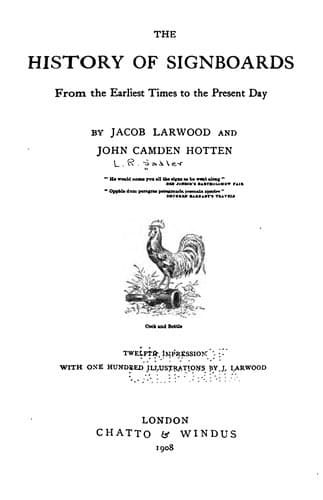
The History of Signboards, from the Earliest times to the Present DayHotten, John Camden
History
The History of Signboards, from the Earliest times to the Present Day
Hotten, John Camden
Inn signs -- England -- History; Signs and signboards -- History
Any forked object, therefore, has the power to drive witches away. Hence
the children in Italy and Spain are generally seen with a piece of
forked coral (coral is particularly efficacious) hung round their necks,
whilst even the mules and other cattle are armed with a small crescent
formed by two boars’ tusks, or else a forked piece of wood, to avert the
spells of what Macbeth calls “the juggling fiends.” Even the two
forefingers held out apart are thought sufficient to avert the evil eye,
or prevent the machinations of the lord and master of the nether world.
Great power also lies in the pentagram and Solomon’s seal, which, being
composed of two triangles, present not less than six forked ends. Both
these figures are much used by the Moors, with the same object in view
as the horseshoe by western nations. In this country, at the present
day, scarcely a stable can be seen where there is not a horseshoe nailed
on the door or lintel; there is one very conspicuous at the gate of
Meux’s brewery at the corner of Tottenham Court Road, and conspicuous on
the horse trappings of this establishment the shoe in polished brass may
be seen; in fact, it has become the trade-mark of the firm, the same as
the red triangle which distinguishes the pale ale of the Burton brewers.
The iron heels of workmen’s boots are also frequently seen fixed against
the doorpost, or behind the door, of houses of the lower classes.
The HORSESHOE, by itself, is comparatively a rare sign. There is a
Horseshoe Tavern, mentioned by Aubrey in connexion with one of those
reckless deeds of bloodshed so common in the sixteenth and seventeenth
centuries:--
“Captain Carlo Fantom, a Croatian, spake 13 languages, was a captain
under the Erle of Essex. He had a world of cuts about his body with
swords and was very quarrelsome and a great ravisher. He met coming
late at night out of the Horseshoe Tavern in Drury Lane with a
lieutenant of Colonel Rossiter, who had great jingling spurs on. Said
he, the noise of your spurrs doe offend me, you must come over the
kennel and give me satisfaction. They drew and passed at each other,
and the lieutenant was runne through and died in an hour or two, and
it was not known who killed him.”[247]
This tavern was still in existence in 1692, as appears from the
deposition of one of the witnesses in the murder of Mountfort the actor
by Captain Hill, who, with his accomplice, Lord Mohun, whilst they were
laying in wait for Mrs Bracegirdle, drank a bottle of canary which had
been bought at the Horseshoe Tavern.
Public-domain text, read in full here on John Shaqi.
Reviews
Reviews
No reviews yet
Be the first to share your thoughts on this work.
Elsewhere in the archive
Join the Discussion
Join the discussion
Sign in to leave a comment or review.
Sign InorCreate an account