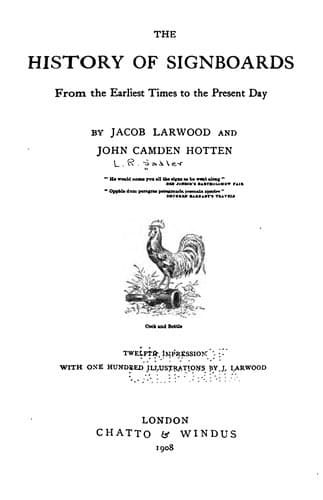
The History of Signboards, from the Earliest times to the Present DayHotten, John Camden
History
The History of Signboards, from the Earliest times to the Present Day
Hotten, John Camden
Inn signs -- England -- History; Signs and signboards -- History
Speaking of birds’ nests figuring as signs, we may mention that, at the
beginning of the present century, the small shops under the tree at the
corner of Milk Street, City, used to describe themselves as “under the
Crow’s Nest, Cheapside.” An old-fashioned snuff shop, still in
existence, issued its tobacco papers in this way, and the small bookshop
there at present advertises itself as “under the tree,” although it was
only very recently that the crow ceased to visit and repair his nest
here.
The THREE COLTS, in Bride Lane, 1652, is represented on a trades token
by three colts running; such a sign gave its name to a street in
Limehouse. The HORSESHOE is a favourite in combination with other
subjects. Aubrey, in his “Miscellanies,” p. 148, says:--
“It is a very common thing to nail horseshoes on the thresholds of
doors, which is to hinder the power of witches that enter into the
house. Most houses of the West End of London have the horseshoe on the
threshold; it should be a horseshoe that one finds.”
Elsewhere he says:--
“Under the Porch of Staninfield Church in Suffolk, I saw a tile with
a horseshoe upon it placed there for this purpose, though one would
imagine that the holy water would have been sufficient.”
Concerning the same superstition Brand observes:--
“I am told there are many other similar instances. In Monmouth Street
(probably the part alluded to by Aubrey) many horseshoes nailed to the
threshold are still to be seen. In 1813 not less than 17 remained,
nailed against the steps of doors. The bawds of Amsterdam believed in
1687, that a horseshoe which had either been found or stolen placed on
the hearth would bring good luck to their houses.”[245]
The charm of the horseshoe lies in its being forked and presenting two
points; thus Herrick says:--
“Hang up _hooks_ and _sheers_, to scare
Hence the hag that rides the mare;
Till they be all over wet
With the mire and the sweat,
This observ’d the manes shall be
Of your horses all knot-free.”[246]
Public-domain text, read in full here on John Shaqi.
Reviews
Reviews
No reviews yet
Be the first to share your thoughts on this work.
Elsewhere in the archive
Join the Discussion
Join the discussion
Sign in to leave a comment or review.
Sign InorCreate an account