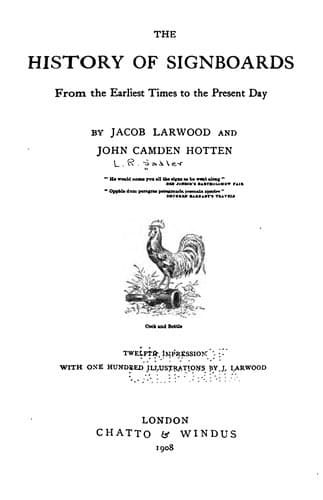
The History of Signboards, from the Earliest times to the Present DayHotten, John Camden
History
The History of Signboards, from the Earliest times to the Present Day
Hotten, John Camden
Inn signs -- England -- History; Signs and signboards -- History
She resolves these questions following:--As to Life whether happy or
unhappy? the best time of it past or to come? Servants or lodgers if
honest or not? To marry the person desir’d or who they shall marry and
when? A Friend if real or not? a Woman with child or not, or ever
likely to have any! A friend absent dead or alive, if alive when
return? Journey by Land or voyages by Sea, the Success thereof.
Lawsuits, which shall gain the better? She also Interprets Dreams.
These and all other lawful questions which for brevity sake are
omitted, she fully resolves.
Her hours are from 7 in the Morning till 12, and from 1 till 8 at
Night.”[250]
These quack “gentlewomen” were as much the order of that day as the
broken-down clergymen who advertise medicines for nervous and rheumatic
complaints are in our own time. Heywood, in his play of “the Wise Woman
of Hogsden,” enumerates the following occupations as their
perquisites:--
“Let me see how many trades have I to live by: First, I am a wise
woman and a fortuneteller, and under that I deale in physick and
fore-speaking, in palmestry and things lost. Next I undertake to cure
madd folks; Then I keepe gentlewomen lodgers, to furnish such chambers
as I let out by the night; Then I am provided for bringing young
wenches to bed; and for a need you see I can play the matchmaker.”
Generally they proclaimed themselves the seventh daughter of a seventh
daughter, a relationship that is still thought to be accompanied by
powers not vouchsafed to ordinary mortals. This belief in the virtue of
the number 7 doubtless originated from the Old Testament, where that
number seems in greater favour than all others. The books of Moses are
full of references to it; the creation of the world in 7 days, sevenfold
vengeance on whosoever slayeth Cain; Noah had to take 7 males and
females of every clean beast, 7 males and females of every fowl of the
air, for in 7 days it would begin to rain; the ark rested in the 7th
month, &c., &c. From this the middle ages borrowed their predilection
for this number, and its cabalistic power.[251]
Horned cattle are just as common as horses on the signboards; the BULL,
in particular, is a favourite with the nation, whether as a namesake--so
much so, indeed, as to have given it a popular name abroad--or as the
source of the favourite roast-beef, or from the ancient sport of
bull-baiting, it is difficult to say. From Ben Jonson we gather that
there was another reason which sometimes dictated the choice of this
animal on the signboard. In the “Alchymist” he introduces a shopkeeper,
who wishes the learned Doctor to provide him with a sign.
“_Face._ What say you to his Constellation, Doctor, the Balance?
_Sub._ _No, that is stale and common:
A Townsman born in Taurus gives the Bull
Or the Bull’s head: in Aries, the Ram,
A poor device._”--ALCHYMIST, a. ii. s. i.
Public-domain text, read in full here on John Shaqi.
Reviews
Reviews
No reviews yet
Be the first to share your thoughts on this work.
Elsewhere in the archive
Join the Discussion
Join the discussion
Sign in to leave a comment or review.
Sign InorCreate an account