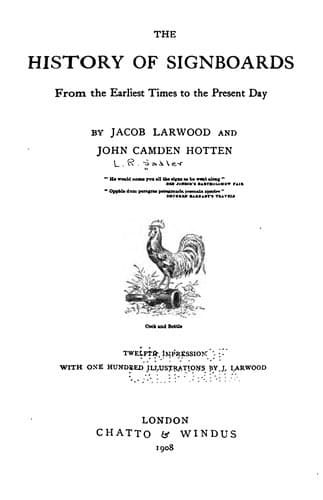
The History of Signboards, from the Earliest times to the Present DayHotten, John Camden
History
The History of Signboards, from the Earliest times to the Present Day
Hotten, John Camden
Inn signs -- England -- History; Signs and signboards -- History
Newton dates a letter from “the Bull,” at Shoreditch, September 1693; it
is addressed to Locke, and a curious letter it is, containing an apology
for having wished Locke dead.
The Bull is generally represented in his natural colour, _black_,
_white_, _grey_, _pied_, “_spangled_” (in Yorkshire,) and only rarely
_red_ and _blue_; yet these two last colours may simply imply the
natural red, brown, and other common hues, for newspapers of the
sixteenth and seventeenth centuries often contain advertisements about
_blue_ dogs; and whatever shade that was intended for, it may certainly
with as much justice be applied to a bull as to a dog. The CHAINED BULL
at North Allerton, Leeds, and the BULL AND CHAIN, Langworthgate,
Lincoln, doubtless refer to the old cruel pastime of bull-baitings.
Occasionally we meet also with a WILD BULL, as at Gisburn, near Skipton.
Leigh Hunt observes:--“London has a modern look to the inhabitants; but
persons who come from the country find as odd and remote-looking things
in it as the Londoners do in York and Chester; and among these are a
variety of old inns with corridors running round the yard. They are well
worth a glance from anybody who has a respect for old times.” Such a one
is the Bull’s Inn in Bishopsgate Street, where formerly plays were
acted by Burbadge, Shakespeare’s fellow-comedian, and Tarlton in good
Queen Bess’s time amused our forefathers on summers’ afternoons with his
quaint jokes and comic parts.[252] This inn is also celebrated as the
London house of the famous Hobson, (Hobson’s choice,) the rich Cambridge
carrier. Here a painted figure of him was to be seen in the eighteenth
century, with a hundred pound bag under his arm, on which was the
following inscription:--“The fruitful Mother of a Hundred More.”[253] At
the Bull public-house on Towerhill, Thomas Otway, the play writer, died
of want at the age of 33, on the 14th of April 1685, having retired to
this house to escape his creditors.[254]
Public-domain text, read in full here on John Shaqi.
Reviews
Reviews
No reviews yet
Be the first to share your thoughts on this work.
Elsewhere in the archive
Join the Discussion
Join the discussion
Sign in to leave a comment or review.
Sign InorCreate an account