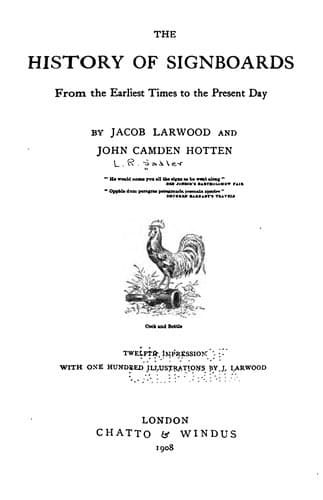
The History of Signboards, from the Earliest times to the Present DayHotten, John Camden
History
The History of Signboards, from the Earliest times to the Present Day
Hotten, John Camden
Inn signs -- England -- History; Signs and signboards -- History
Still more puzzling is the BULL AND BEDPOST; but as the actual use of
this sign as a house decoration remains to be corroborated, we may
dismiss it with the remark, that the Bedpost, in all probability, was a
jocular name for the stake to which the bull was tied when being
baited, in allusion to the stout stick formerly used in bed-making to
smooth the clothes in their place. The BULL AND SWAN, High Street,
Stamford, may be heraldic, both these animals being badges of the York
family; but the Swan in all probability was the first sign, the Bull
being added on account of the singular custom of Bull Running, which
yearly took place, both at Tamworth and Stamford, on St John’s eve. THE
BULL IN THE POUND, is the Bull punished for trespass, and put in the
pound or pinfold; whilst the BULL AND OAK at Wicker, Sheffield, (at
Market Bosworth there is a house with the sign of the BULL IN THE OAK,)
_may_ have originated from the sign of “the Bull” being suspended from
an oak tree, or referring to an oak tree standing near the house. Bulls
are often tied to trees or posts in pastures, and this also may have
given rise to the sign.
Visitors to the Isle of Wight will have noticed the word BUGLE
frequently inscribed under the picture of a Bull on the inn signboards
there. Bugle is a provincial name in those parts for a wild bull. It is
an old English word, and is used by Sir John Mandeville; “homes of grete
oxen, or of _bugles_, or of kygn.” It was still current in the
seventeenth century, for Randle Holme, 1688, classes the “Bugle, or
Bubalus,” amongst “the savage beasts of the greater sort.” The horns of
this animal, used as a musical instrument, gave a name to the Buglehorn.
It may be remarked that the term _bugle_ doubtless came, in old times,
with other Gallicisms common to Sussex and Hampshire, from across the
Channel, where the word _bugle_ is still preserved in the verb
_beugler_, the common French word for the lowing of cattle.
The OX is rather uncommon; the DURHAM OX and the CRAVEN OX, two famous
breeds, are sometimes met with; then there is a CRAVEN OX HEAD, in
George Street, York, and a GREY OX at Brighouse, in the West Riding. The
OX AND COMPASSES at Poulton Swindon, in Cumberland, is evidently a
jocular imitation of the London sign of the Goat and Compasses.
The COW is more common; its favourite colours being RED, BROWN, WHITE,
SPOTTED, SPANGLED, &c. The Red Cow occurs as a sign near Holborn
Conduit, on the seventeenth century trades tokens. It also gave a name
to the alehouse in Anchor and Hope Lane, Wapping, in which Lord
Chancellor Jeffries was taken prisoner, disguised as a sailor, and
trying to escape to the Continent after the abdication of James II.
Thinking himself safe in this neighbourhood, he was looking out of the
window to while the time away, when he was recognised by a clerk who
bore him a grudge, and at once betrayed him. An heraldic origin is not
necessary for this colour of the cow.
Public-domain text, read in full here on John Shaqi.
Reviews
Reviews
No reviews yet
Be the first to share your thoughts on this work.
Elsewhere in the archive
Join the Discussion
Join the discussion
Sign in to leave a comment or review.
Sign InorCreate an account