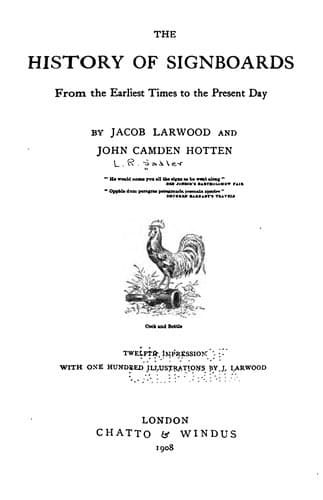
The History of Signboards, from the Earliest times to the Present DayHotten, John Camden
History
The History of Signboards, from the Earliest times to the Present Day
Hotten, John Camden
Inn signs -- England -- History; Signs and signboards -- History
The BULL’S NECK is a sign at Penny Hill, Holbeach, and the BUFFALO HEAD
is common in many places. The latter was the sign of one of the
coffee-houses near the Exchange, during the South Sea bubble, and was
hung up over the head quarters of a company for a grand dispensary,
capital £3,000,000. The rage for joint-stock companies had come to such
a pitch at that period, that an advertisement appeared stating:--
“THIS DAY the 8th instant at Sam’s Coffeehouse behind the Royal
Exchange, at three in the afternoon, a book will be opened, for
entering into a joint copartnership for carrying on a _thing_ that
will turn to the advantage of those concerned.”
Not less than £28,000,000 were asked for at that period to enter upon
various speculations. At the Buffalo Head Tavern, Charing Cross, Duncan
Campbell, the deaf and dumb fortune-teller, used at one time to deliver
his oracles. He is immortalised in the _Spectator_, No. 474, where, in
answer to the letter of a lady inquiring about Duncan’s address, a note
is entered, “That the Inspector I employ about Wonders, inquire at the
Golden Lyon, opposite the Halfmoon Tavern, Drury Lane, into the merit of
this silent sage.”[260]
Among the combinations in which the Bull is met with on signboards, the
BULL AND DOG is one of the most common, derived, like the Bull and
Chain, from the favourite sport of bull-baiting, which amusement is
described at full length and in brilliant colours by Misson, in his
“Travels.” A comical variation of this is the BULL AND BITCH at Husborn
Crawley, Woburn. In the sign of the BULL AND BUTCHER,[261] the bull is
placed in still worse company; this was very forcibly expressed on the
sign of a butcher in Amsterdam, who was represented with a glass of wine
in his hand, standing between two calves, and pledging them with the
cruel words,--
“Zyt verblyt
Soo lang gy er zyt.”[262]
The BULL AND MAGPIE, which occurs at Boston, has been explained as
meaning the Pie, πιναξ, and the Bull of the Romish Church; but this
looks very like a cock-and-bull story. As “some help to thicken other
proofs that also demonstrate thinly,” as Iago has it, it may be asked
whether this might not have arisen out of the sign of the “Pied Bull,”
thus leading to the “Pie and Bull,” or the “Bull and Magpie;” the
transition seems simple and easy enough; but should this not be
considered satisfactory, since we have the “Cock and Bull,” and the
“Cock and Pie,” we may by a sort of rule of three manœuvre obtain the
Bull and Pie or Magpie. _See under_ Bird Signs.
The BLACK BULL AND LOOKING-GLASS is named in an advertisement in the
original edition of the _Spectator_, No. lxviii., as a house in
Cornhill. It was evidently a combination of two signs.
Public-domain text, read in full here on John Shaqi.
Reviews
Reviews
No reviews yet
Be the first to share your thoughts on this work.
Elsewhere in the archive
Join the Discussion
Join the discussion
Sign in to leave a comment or review.
Sign InorCreate an account