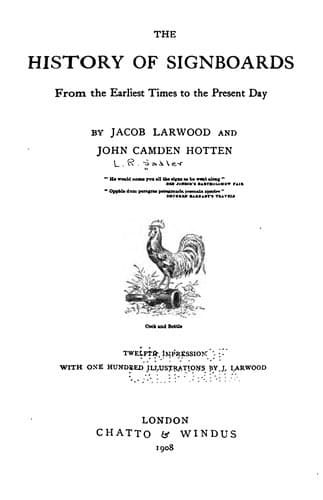
The History of Signboards, from the Earliest times to the Present DayHotten, John Camden
History
The History of Signboards, from the Earliest times to the Present Day
Hotten, John Camden
Inn signs -- England -- History; Signs and signboards -- History
The Heifer is to be met with sometimes in Yorkshire, but always with
some local adjective, as the CRAVEN HEIFER; the AIRESDALE HEIFER, the
DURHAM HEIFER, &c. The PIED CALF at Spalding seems to present a solitary
instance of a calf on the signboard. Neither are sheep very common; the
RAM was a noted carrier’s inn in the seventeenth century, in West
Smithfield, and, indeed, continued as such until the recent destruction
of this old cattle market. The crest of the cloth-workers was a mount
vert, thereon a ram statant; so that this sign in that locality was very
well chosen, being in honour of the cattle-dealers on ordinary
occasions, and serving for the cloth-workers in the time of Bartholomew
fair, for whose benefit the fair was founded. In 1668 there were two
RAM’S HEAD inns in Fenchurch Street; one of them was a carriers’ inn for
the Essex people. The RAM’S SKIN, which occurs at Spalding in
Lincolnshire, is another name for the Fleece. The BLACK TUP figures on a
sign near Rochdale, perhaps in allusion to the black ram frail matrons
used to bestride in the old custom of _Free Bench_, thus related in
Jacob’s “Law Dictionary:”--
“In the manors of East and West-Enbourne in the Co. of Berks, and the
manor of Torre in Devonshire, and other parts of the West of England,
there is a custom, that when a Copyhold Tenant dies his widow shall
have ‘Free Bench’ in all his customary lands ‘dum sola et casta
fuerit,’ but if she commits incontinency she forfeits her estate. Yet
nevertheless on her coming into the court of the manor, riding
backwards on a _black ram_ with his tail in her hand and saying the
words following, the steward is bound by the custom to readmit her to
her free bench; The words are these:--
Here I am
Riding upon a Black Ram
Like a w----e as I am;
And for my crincum crancum
I have lost my bincum bancum;
And for my T----’s game
Have done this worldly shame.
Therefore pray, Mr Steward, let me have my land again.
This is a kind of penance among jocular tenures to purge the offence.”
Though the ram is rarely, and the sheep never seen on the signboard, the
LAMB is not uncommon. In 1586, it was the sign of Abraham Veale,
(agreeably to the punning practices of the time, one would have expected
the _Calf_ from him,) a bookseller in St Paul’s Churchyard, and in 1728
of Thomas Cox, also a bookseller, under the Royal Exchange in Cornhill.
Doubtless, these signs had originally represented the Lamb with the flag
of the Apocalypse. The sign was used by other trades: in 1673, it was
the distinctive ornament of a confectioner at the lower end of
Gracechurch Street;[266] and an instance of an alehouse is found in the
following advertisement, which at the same time affords us a peep at the
homely proceedings of the Admiralty in those days:--
Public-domain text, read in full here on John Shaqi.
Reviews
Reviews
No reviews yet
Be the first to share your thoughts on this work.
Elsewhere in the archive
Join the Discussion
Join the discussion
Sign in to leave a comment or review.
Sign InorCreate an account