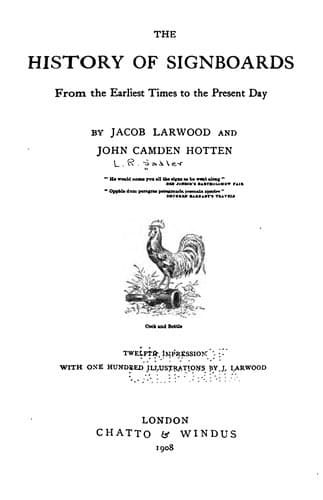
The History of Signboards, from the Earliest times to the Present DayHotten, John Camden
History
The History of Signboards, from the Earliest times to the Present Day
Hotten, John Camden
Inn signs -- England -- History; Signs and signboards -- History
“THIS is to give notice to the Officers and Company of His Majesty’s
Frigate Boreas, who were on Board her at the taking the Ship Vrow
Jacoba and Briggantyne Leon, that they will be paid their respective
Shares of said Prizes, on Wednesday the Eight of April next, at the
sign of _the Lamb_, in Abchurch Lane. Paying will begin at Eight
o’clock of the forenoon of the said Day.”[267]
Think of that, ye clerks in Her Majesty’s offices, eight o’clock in the
forenoon!
A few combinations also occur, as the LAMB AND BREECHES, the sign of
Churches & Christie, leather-sellers and breeches-makers, on London
Bridge, in the last century; this was a sign like that of the HAT AND
BEAVER, in which the living animal, and the article manufactured from
its skin, were juxtaposed. The LAMB AND CROWN was a sort of colonial or
emigration office in Threadneedle Street, near the Southsea House in
1759.[268] At the present day there is a LAMB AND LARK at Keynsham,
Bath, and in Printing House Lane, Blackfriars. It is a typical
representation of the proverb, “Go to bed with the _Lamb_ and rise with
the _Lark_.”
The LAMB AND HARE figure together in Portsmouth Place, Lower Kennington
Lane. The LAMB AND STILL is a combination intimating the sale of
distilled waters. It was the sign of a house in Compton Street, in 1711,
which had the honour to lodge Mr Fert, a dancing-master, and author of
a work called “A Discourse or Explanation of the _ground_ of
Dancing.”[269]
If we except the heraldic Blue Boar, and the Sow and Pigs, we shall find
no other pigs on the signboard but the PIG AND WHISTLE,[270] the LITTLE
PIG at Amblecote, Stourbridge, and the HOG IN THE POUND in Oxford
Street, jocularly called the _gentleman in trouble_. This latter was
formerly a starting-point for coaches, and became notorious through the
crime committed by its landlady, Catherine Hayes. Having formed an
illicit connexion, she was induced by her paramour to murder her
husband, after which she cut off his head, put it in a bag, and threw it
in the Thames. It floated ashore, and was put on a pole in St Margaret’s
Churchyard, Westminster, in order that it might be recognised; and by
this primitive means the murderess was detected. The man was hanged, and
Catherine burnt alive at Tyburn in 1726.
The GOAT is not very common; there was a Goat Inn at Hammersmith, taken
down in 1826, and rebuilt under the name of Suspension Bridge Inn; up to
that time, the sign, and the woodwork from which it was suspended, used
to extend across the street. The GOAT IN BOOTS, on the Fulham Road,[271]
was in old times called simply “the Goat.” Besides these, there is a
BLACK GOAT in Lincoln, and a GREY GOAT in Penrith and Carlisle, and a
few others without addition of colour.
Public-domain text, read in full here on John Shaqi.
Reviews
Reviews
No reviews yet
Be the first to share your thoughts on this work.
Elsewhere in the archive
Join the Discussion
Join the discussion
Sign in to leave a comment or review.
Sign InorCreate an account