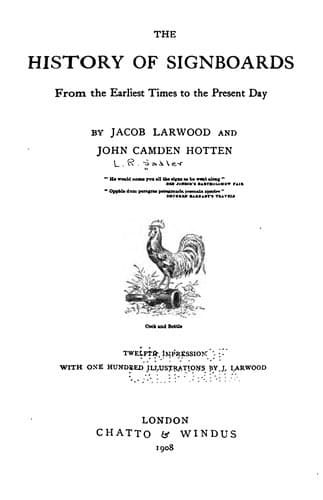
The History of Signboards, from the Earliest times to the Present DayHotten, John Camden
History
The History of Signboards, from the Earliest times to the Present Day
Hotten, John Camden
Inn signs -- England -- History; Signs and signboards -- History
Sometimes a peculiar breed is chosen, as the SETTER DOG at Redford,
Notts; the POINTER at Peckfield, Milford Junction; the BEAGLE at Shute,
Axminster, and the MERRY HARRIERS, common in hunting counties. Equally
common is the GREYHOUND, particularly in the North country, where
coursing has long been a favourite sport. In the seventeenth century, it
was the sign of a fashionable tavern in London, for in a sprightly
ballad in the Roxburgh collection,[273] a young gallant is introduced
who is going to forsake his evil courses and turn over a new leaf. He
gives a last farewell to all his _doxies_:
“Farewell unto black patches,
And farewell powder’d locks;”
and remembers all those delightfully wicked places he used to haunt
formerly, and amongst them:
“Farewell unto the GREYHOUND,
And farewell to the Bell,
And farewell to my landlady,
Whom I do love so well.”
This was probably the same Greyhound mentioned by Machyn, which seems to
have been situated in Fleet Street, where the gaudily dressed Spanish
ambassador took his stirrup-cup before leaving London. The same author
mentions the sign elsewhere, apparently in Westminster; and the little
picture of manners which accompanies it is rather curious:--
“The viij day of January (1557) dyd ryd in a care in Westmynster the
wyff of the Grayhound, and the Abbot’s servand was wypyd [whipped]
becawse that he toke her owt of the car, at the care h--e, [the back
of the cart.]”
--another example that the course of true love never does run smooth,
even though it runs upon wheels.
The WHITE GREYHOUND was the sign of John Harrison, in St Paul’s
Churchyard, a bookseller who published some of Shakespeare’s early
works, as “The Rape of Lucrece,” “Venus and Adonis,” &c. White
greyhounds, or rather silver greyhounds, were, until eighty years ago,
the badges worn on the arm by king’s messengers.
The sign of the BLACK GREYHOUND is also of frequent occurrence, and at
Grantham there is a BLUE GREYHOUND. Indeed, although Lincoln was
formerly famous for green, it seems also to have taken a great fancy to
blue, for there we find the BLUE BULL and the BLUE COW, the BLUE DOG,
the BLUE FOX, (all in Colsterworth,) besides the BLUE PIG, the BLUE RAM,
in Grantham, which town can also boast of the unique sign of the BLUE
MAN.
Public-domain text, read in full here on John Shaqi.
Reviews
Reviews
No reviews yet
Be the first to share your thoughts on this work.
Elsewhere in the archive
Join the Discussion
Join the discussion
Sign in to leave a comment or review.
Sign InorCreate an account