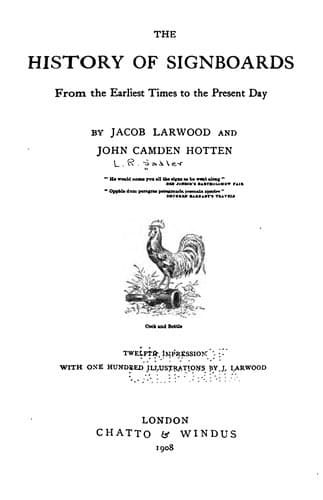
The History of Signboards, from the Earliest times to the Present DayHotten, John Camden
History
The History of Signboards, from the Earliest times to the Present Day
Hotten, John Camden
Inn signs -- England -- History; Signs and signboards -- History
Mr Akerman, in his work on “Trades Tokens issued between 1648-1672,”
makes a mistake in surmising that Luke Hutton’s “Black Dog of Newgate”
had anything to do with this tavern. That poem is simply against
“coney-catchers,” _i.e._, roguish detectives or informers of the
Jonathan Wild stamp, and even worse. Such a one is impersonificated
under the name of the Black Dog of Newgate, because the coney-catchers
used to hunt people down threatening them with Newgate. This Black Dog
may have derived its name from the canine spectre that still frightens
the ignorant and fearful in our rural districts, just as the terrible
Dun Cow, and the Lambton Worm were the terror of the people in old
times. Near Lyme Regis, Dorset, there is an alehouse which has this
black fiend in all his ancient ugliness painted over the door. Its
adoption there arose from a legend that the spectral black dog used to
haunt at nights the kitchen fire of a neighbouring farm-house, formerly
a Royalist mansion, destroyed by Cromwell’s troops. The dog would sit
opposite the farmer; but one night, a little extra liquor gave the man
additional courage, and he struck at the dog, intending to rid himself
of the horrid thing. Away, however, flew the dog and the farmer after
him, from one room to another, until it sprang through the roof, and was
seen no more that night. In mending the hole, a lot of money fell down,
which, of course, was connected in some way or other with the dog’s
strange visit. Near the house is a lane still called Dog Lane, which is
now the favourite walk of the black dog, and to this _genius loci_ the
sign is dedicated.
There was another notorious Black Dog next door to the Devil Tavern, the
shop of Abel Roper, who printed and distributed the majority of the
pamphlets and ballads that paved the way for the Revolution of 1688. He
was the original printer of the famous ballad of “Lillibulero.” Whatever
pleased the public, whether good or bad, he was always ready to provide
and send into the world; he was also the editor of the newspaper called
the _Postman_. In the beginning of the reign of Charles II. he lived “at
the Sun, over against St Dunstan’s Church, in Fleet Street.”[272]
Tokens are extant of the PIED DOG in Seething Lane, 1667, a sign still
frequently to be seen at the present day.
We very rarely meet with the BLUE DOG; but there is an example in
Grantham, and the sign occurs in a few other places.
Public-domain text, read in full here on John Shaqi.
Reviews
Reviews
No reviews yet
Be the first to share your thoughts on this work.
Elsewhere in the archive
Join the Discussion
Join the discussion
Sign in to leave a comment or review.
Sign InorCreate an account